Conference House
Also known as: Billopp House

Why it's listed
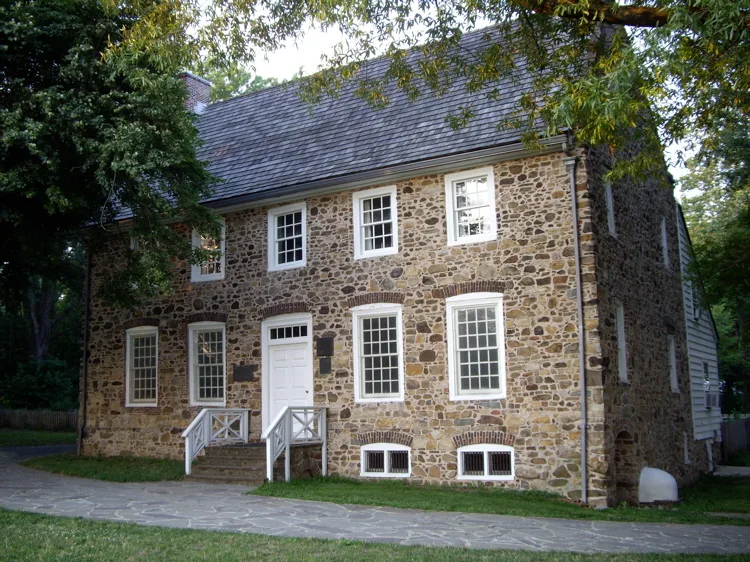
Built around 1680 by Christopher Billopp on a 1,600-acre estate he called Bentley, this two-story stone manor house overlooks Raritan Bay at Tottenville, Staten Island. Its steep gable roof, end chimneys and stone walls suggest Dutch rather than Georgian influence. Inside, a first-floor room with a large fireplace, exposed beams and old floorboards is known as the Conference Room, and a basement holds a cooking fireplace and a brick-vaulted chamber. The house is best known for September 11, 1776, when Lord Richard Howe received Benjamin Franklin, John Adams and Edward Rutledge here. Howe sought to end the rebellion, but the Americans remained committed to independence, and the talks ended after about three hours. British forces occupied the house for the rest of the war. New York City acquired the dilapidated building in 1926, and a 1932 restoration returned it to its 18th-century look. It now serves as a museum on a 2.75-acre parcel of park grounds.
Significance in brief: On September 11, 1776, the house hosted a peace conference between Lord Richard Howe and American representatives John Adams, Benjamin Franklin and Edward Rutledge. The talks failed because the British could not recognize American independence and the Americans held to the Declaration of Independence. The site is significant for its link to the War for Independence.
Machine-generated summary. This summary was generated by a language model from the official nomination document and has not been reviewed line by line by an editor. It may contain errors. Check the source document before relying on any detail. Source: nomination document (PDF) · National Archives catalog entry. NRHP reference 66000566, listed October 15, 1966. Summary generated October 2026 (model claude-sonnet-5-5, prompt v1.0-2026-10-29, confidence high).
Key facts
| Address | Hylan Blvd., New York |
|---|---|
| County | Staten Island |
| Listed | October 15, 1966 |
| Reference number | 66000566 |
| Resource type | Building |
| Period of significance | 1700-1799 |
| Architect / builder | Christopher Billopp (builder) |
| Architectural style | Suggests Dutch rather than Georgian influence |
| Areas of significance | Military, Politics/Government |
| Level of significance | National |
| National Historic Landmark | Yes, designated May 23, 1966 |
| Status (as stated in the nomination) | Restored in 1932 to its 18th-century appearance; condition listed as excellent; maintained as a museum on city-owned parkland. |
| Acreage | 2.8 |
| Coordinates | 40.50286, -74.25356 (NPS GIS) |
What listing means for this property
National Register listing is honorary for a privately owned home: it does not by itself restrict what an owner may do with their own money, and it does not require public access. Restrictions come from local landmark or historic-district ordinances, which are separate (how they differ).
Owner-occupied houses are not eligible for the 20% federal rehabilitation tax credit, which applies to income-producing buildings, but many states offer credits for homeowners. Listing also opens the door to preservation easements and to buying a plaque. Start with what listing means for homeowners, renovating a listed house and selling one.
General information, not legal or tax advice. Rules change; confirm with your State Historic Preservation Office or a qualified adviser.
Sources and further reading
- National Park Service, National Register of Historic Places database (snapshot May 2026), reference 66000566.
- Nomination form (PDF, National Archives) — catalog entry
- Wikipedia article (used for cross-checking only; text not reproduced here)
- Wikidata Q3849604
- This listing as JSON
Last updated October 2026. Found an error? See the editorial policy for how to report it.