Bull, Julius and Harriet, House
Also known as: Ferry Farm

Why it's listed
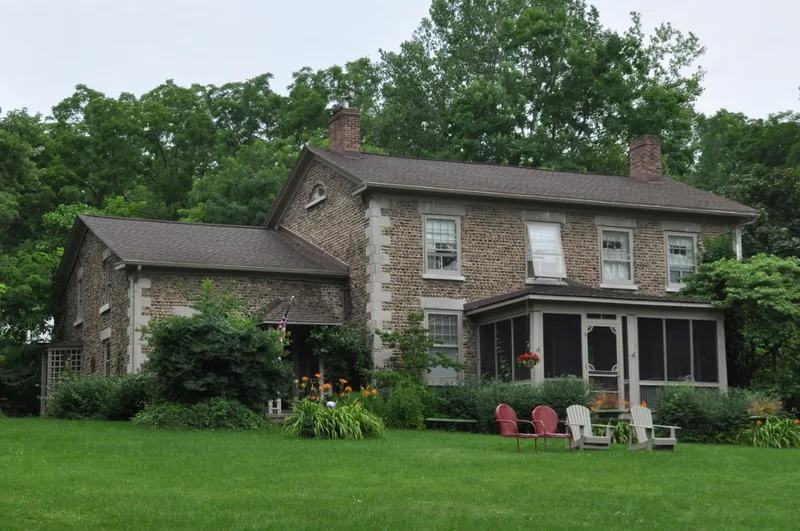
Built in 1830 on a 246-acre farm beside Cayuga Lake, this two-story cobblestone house near Seneca Falls is also known as Ferry Farm. Its walls are laid with variously colored field cobbles, with untooled limestone quoins and flat stone lintels. The doorway trim shows late Federal and early Greek Revival influence, and the interior keeps its original room layout, plaster walls, simple woodwork and hardwood floors. A later carriage barn and workshop also stands on the lot. Julius and Harriet Bull, who bought the farm in 1830, were active abolitionists. Julius signed an 1850 antislavery petition and several Free Soil Party notices in 1848, and both Bulls belonged to the antislavery Wesleyan Methodist Church in Seneca Falls. Local tradition holds that fugitives from slavery were brought across the lake to the farm, and the documents call this plausible though not conclusively proven. The house is also valued as a well-preserved example of cobblestone building in New York.
Significance in brief: The nomination argues significance under Criterion A for the house's association with Julius and Harriet Bull, documented abolitionists in Seneca County who signed antislavery petitions and Free Soil notices and belonged to the Wesleyan Methodist Church. Local tradition links the farm to the Underground Railroad, though direct evidence is circumstantial. Under Criterion C, it is a remarkably intact example of New York cobblestone architecture.
Machine-generated summary. This summary was generated by a language model from the official nomination document and has not been reviewed line by line by an editor. It may contain errors. Check the source document before relying on any detail. Source: nomination document (PDF) · National Archives catalog entry. NRHP reference 07000869, listed August 30, 2007. Summary generated October 2026 (model claude-sonnet-5-5, prompt v1.0-2026-10-29, confidence medium).
Key facts
| Address | 2534 Lower Lake Rd., Seneca Falls |
|---|---|
| County | Seneca County |
| Listed | August 30, 2007 |
| Reference number | 07000869 |
| Resource type | Building |
| Period of significance | 1830 - 1850s |
| Architectural style | Early 19th Century: vernacular (late Federal/early Greek Revival details) |
| Criteria |
|
| Areas of significance | Black, Social History, Architecture |
| Level of significance | Local |
| Status (as stated in the nomination) | Still used as a single-family dwelling; the interior and exterior retain a high degree of original integrity. |
| Acreage | 1.9 |
| Coordinates | 42.90384, -76.75099 (NPS GIS) |
What listing means for this property
National Register listing is honorary for a privately owned home: it does not by itself restrict what an owner may do with their own money, and it does not require public access. Restrictions come from local landmark or historic-district ordinances, which are separate (how they differ).
Owner-occupied houses are not eligible for the 20% federal rehabilitation tax credit, which applies to income-producing buildings, but many states offer credits for homeowners. Listing also opens the door to preservation easements and to buying a plaque. Start with what listing means for homeowners, renovating a listed house and selling one.
General information, not legal or tax advice. Rules change; confirm with your State Historic Preservation Office or a qualified adviser.
Sources and further reading
- National Park Service, National Register of Historic Places database (snapshot May 2026), reference 07000869.
- Nomination form (PDF, National Archives) — catalog entry
- Wikipedia article (used for cross-checking only; text not reproduced here)
- Wikidata Q6310177
- This listing as JSON
Last updated October 2026. Found an error? See the editorial policy for how to report it.