North Blenheim Historic District
Also known as: See Also:Old Blenheim Bridge

Why it's listed
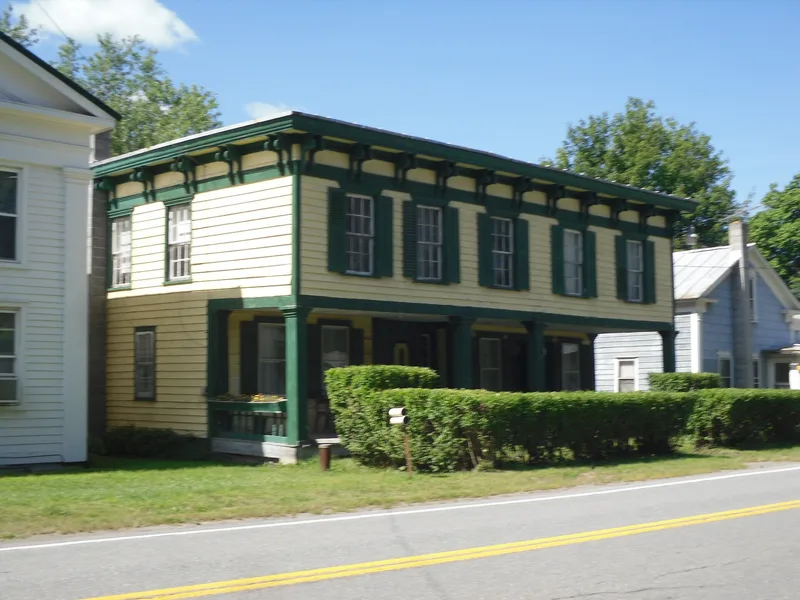
North Blenheim is a long, narrow village in Schoharie County, New York, strung along Route 30 on the west side of Schoharie Creek and split by a steep hillside into Upper and Lower Streets. About two thirds of its roughly thirty buildings show Greek Revival influence. The best known is a wooden church built in 1841, with a pediment, flat pilasters, a square bell tower and Ionic columns framing the entrance, flanked by a manse and a residence of similar quality. A Methodist church from 1828, later remodeled, and a few bracketed, flat-roofed buildings reflect later 19th-century tastes. The village was settled by Palatine Germans and grew around mills on the West Kill, becoming a trading center for surrounding farms. An 1872-73 gazetteer listed two churches, two hotels, several shops and about 50 dwellings. Its significance rests on how intact the village remains and on the consistent scale of its buildings, alongside the Old Blenheim Covered Bridge, which residents saved from loss in 1930.
Significance in brief: The district is significant as an intact mid-19th century village with a strong Greek Revival character, including a notable 1841 church flanked by two residences. Its value lies in the intactness of its buildings and the compatible scale of the whole, rather than in any single outstanding house. It also forms the setting for the Old Blenheim Covered Bridge, a National Historic Landmark.
Machine-generated summary. This summary was generated by a language model from the official nomination document and has not been reviewed line by line by an editor. It may contain errors. Check the source document before relying on any detail. Source: nomination document (PDF) · National Archives catalog entry. NRHP reference 74001303, listed December 31, 1974. Summary generated October 2026 (model claude-sonnet-5-5, prompt v1.0-2026-10-29, confidence medium).
Key facts
| Address | Both sides of NY 30, beside Schoharie Creek, Blenheim |
|---|---|
| County | Schoharie County |
| Listed | December 31, 1974 |
| Reference number | 74001303 |
| Resource type | District |
| Period of significance | 19th Century |
| Architectural style | Greek Revival |
| Areas of significance | Agriculture, Architecture |
| Level of significance | Local |
| Status (as stated in the nomination) | Condition is marked good; the village is described as remarkably well preserved and largely free of modern intrusions. Present uses include commercial, private residence and religious. |
| Acreage | 28 |
| Coordinates | 42.47027, -74.45043 (NPS GIS) |
What listing means for this property
This is a historic district. Buildings within its boundary are either contributing (they add to the district's significance) or non-contributing. Owners of contributing income-producing buildings can claim the 20% federal rehabilitation tax credit; homeowners should look at state credits. National Register districts impose no design review by themselves; a local historic district ordinance, if one exists, does (the difference explained).
General information, not legal or tax advice. Rules change; confirm with your State Historic Preservation Office or a qualified adviser.
Sources and further reading
- National Park Service, National Register of Historic Places database (snapshot May 2026), reference 74001303.
- Nomination form (PDF, National Archives) — catalog entry
- Wikipedia article (used for cross-checking only; text not reproduced here)
- Wikidata Q14707110
- This listing as JSON
Last updated October 2026. Found an error? See the editorial policy for how to report it.