Lansing Manor House

Why it's listed
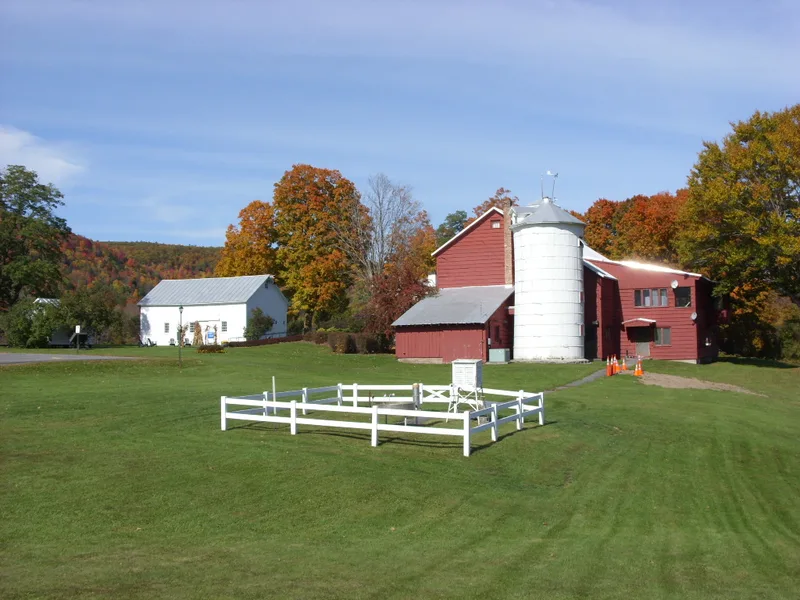
Lansing Manor House is a two-story hipped-roof house of about 1818, set on a plateau overlooking Schoharie Creek about two miles south of North Blenheim. It has a brick-lined frame first story, a wood frame second story, lapped siding, and a five-bay porch across the front. Notable details include a fanlight at the entrance and a small oval window on the south side. Nine original fireplaces still work, and a cellar holds the original kitchen and servants' quarters. Farm outbuildings include a summer kitchen, ice house, milk house, barn and silos. John Lansing Jr., a former Chancellor of New York, gave the property to his son-in-law Jacob Sutherland, a lawyer sent to manage the estate, and the house was built for him and his family. The property lies within the Blenheim Patent of 1769 and later saw anti-rent activity. It operated as a livestock and grain farm into the twentieth century, and the house has changed little since its construction.
Significance in brief: The house is a visible reminder of rapid settlement after the 1769 Fort Stanwix Treaty, of life under the Patent land grants, and of the anti-rent wars of the 1840s. The estate operated as a successful farm in the nineteenth and twentieth centuries. The house is also significant architecturally as an early manor house that retains most of its original integrity.
Machine-generated summary. This summary was generated by a language model from the official nomination document and has not been reviewed line by line by an editor. It may contain errors. Check the source document before relying on any detail. Source: nomination document (PDF) · National Archives catalog entry. NRHP reference 73001268, listed May 25, 1973. Summary generated October 2026 (model claude-sonnet-5-5, prompt v1.0-2026-10-29, confidence medium).
Key facts
| Address | 2 mi. S of North Blenheim on NY 30, Blenheim |
|---|---|
| County | Schoharie County |
| Listed | May 25, 1973 |
| Reference number | 73001268 |
| Resource type | District |
| Period of significance | 19th Century (specific date c. 1800 noted) |
| Areas of significance | Politics/Government, Architecture |
| Level of significance | Local |
| Status (as stated in the nomination) | Rated good condition with few alterations; occupied and used as a private residence. Owned by the New York State Power Authority and expected to become part of a new state park facility. |
| Acreage | 300 |
| Coordinates | 42.45321, -74.46387 (NPS GIS) |
What listing means for this property
This is a historic district. Buildings within its boundary are either contributing (they add to the district's significance) or non-contributing. Owners of contributing income-producing buildings can claim the 20% federal rehabilitation tax credit; homeowners should look at state credits. National Register districts impose no design review by themselves; a local historic district ordinance, if one exists, does (the difference explained).
General information, not legal or tax advice. Rules change; confirm with your State Historic Preservation Office or a qualified adviser.
Sources and further reading
- National Park Service, National Register of Historic Places database (snapshot May 2026), reference 73001268.
- Nomination form (PDF, National Archives) — catalog entry
- Wikipedia article (used for cross-checking only; text not reproduced here)
- Wikidata Q6487471
- This listing as JSON
Last updated October 2026. Found an error? See the editorial policy for how to report it.