Christman Bird and Wildlife Sanctuary

Why it's listed
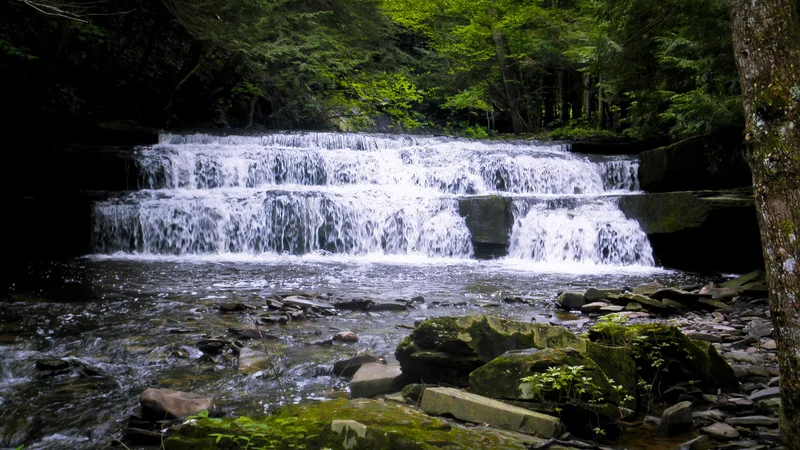
Set in the valley of the Bozenkill, this 105-acre tract of mostly wooded land near Delanson and Duanesburg operates as a bird and wildlife sanctuary. The creek drops over a thirty-foot waterfall, and hemlock, oak, beech and cherry shelter wildlife. Old farm fields have been reforested, and the buildings include an 1868 frame house, the older house where W. W. Christman was born in 1865, a stone dairy house, barns, stone walls and a lean-to built in 1934. The sanctuary began in 1888, when Christman and his wife started feeding birds during a great blizzard. He later planted pine, spruce and larch on his stony land, wrote nature poetry and essays, and corresponded with Walt Whitman and John Burroughs. State conservation officials and the Mohawk Valley Hiking Club formally dedicated it in 1931. The nomination values it as evidence of early conservation activity in New York.
Significance in brief: The sanctuary is argued to be significant in the history of conservation in New York State. W. W. Christman began winter bird feeding here in 1888, reforested stony farmland in the 1920s, and wrote nature poetry and essays. The land and buildings are cited as tangible evidence of his early participation in the conservation movement.
Machine-generated summary. This summary was generated by a language model from the official nomination document and has not been reviewed line by line by an editor. It may contain errors. Check the source document before relying on any detail. Source: nomination document (PDF) · National Archives catalog entry. NRHP reference 70000433, listed August 25, 1970. Summary generated October 2026 (model claude-sonnet-5-5, prompt v1.0-2026-10-29, confidence high).
Key facts
| Address | Schoharie Tpke., Delanson |
|---|---|
| County | Schenectady County |
| Listed | August 25, 1970 |
| Reference number | 70000433 |
| Resource type | District |
| Period of significance | 19th and 20th Century; specific date 1888 |
| Areas of significance | Conservation, Literature, Education, Agriculture |
| Level of significance | State |
| Status (as stated in the nomination) | Condition listed as excellent and unaltered, on its original site; occupied, privately owned, and used as a bird and wildlife sanctuary with restricted public access. |
| Acreage | 105 |
| Coordinates | 42.74080, -74.12456 (NPS GIS) |
What listing means for this property
This is a historic district. Buildings within its boundary are either contributing (they add to the district's significance) or non-contributing. Owners of contributing income-producing buildings can claim the 20% federal rehabilitation tax credit; homeowners should look at state credits. National Register districts impose no design review by themselves; a local historic district ordinance, if one exists, does (the difference explained).
General information, not legal or tax advice. Rules change; confirm with your State Historic Preservation Office or a qualified adviser.
Sources and further reading
- National Park Service, National Register of Historic Places database (snapshot May 2026), reference 70000433.
- Nomination form (PDF, National Archives) — catalog entry
- Wikipedia article (used for cross-checking only; text not reproduced here)
- Wikidata Q5111242
- This listing as JSON
Last updated October 2026. Found an error? See the editorial policy for how to report it.