Oakcliff

Why it's listed
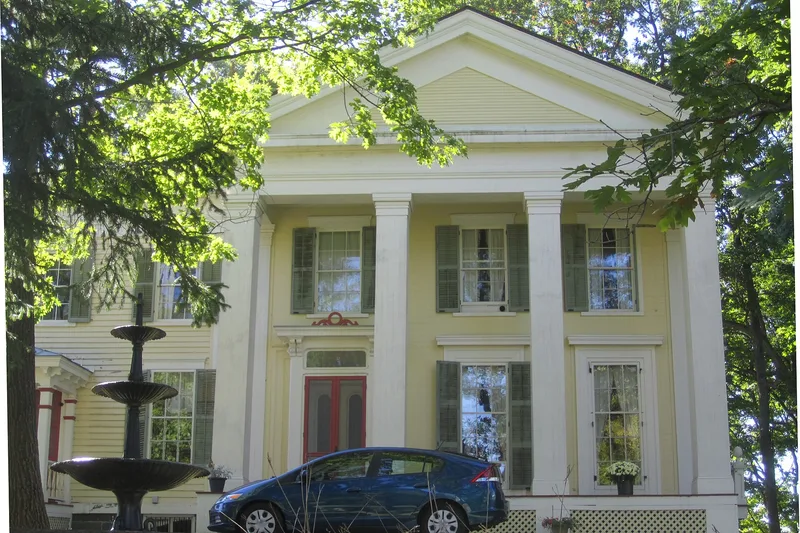
Oakcliff is a large Greek Revival frame house set on a high bluff north of the Mohawk River in Crescent, Saratoga County. Built about 1840 for Judge Duncan McMartin, it has a side-hall plan, a cut stone foundation and an unusual pair of formal fronts, each with a two-story portico of four Tuscan columns beneath a pediment. A frame carriage barn and a stone well also contribute to the 1.4-acre property. The house grew over time: the main block was extended and the side wing raised in the late 1860s, and servants' quarters, a butler's pantry and a bathroom were added in the 1890s. From about 1850 to 1882 it was the home of Thomas G. Younglove, a Cohoes businessman and Speaker of the New York State Assembly, and his family kept it until 1906. Its architecture, riverside setting and connection to Erie Canal-era prosperity underpin its significance. Recent rehabilitation has restored its character.
Significance in brief: The property is significant under Criterion C as a refined, highly intact example of Greek Revival residential architecture in the Hudson-Mohawk region. It is unusual for its two formal facades, each with a monumental portico, and for its picturesque bluff setting. The house also shows how a country seat changed with the 1860s and 1890s remodelings. The Keeper's amendment states that Criterion A does not apply.
Machine-generated summary. This summary was generated by a language model from the official nomination document and has not been reviewed line by line by an editor. It may contain errors. Check the source document before relying on any detail. Source: nomination document (PDF) · National Archives catalog entry. NRHP reference 98000548, listed June 1, 1998. Summary generated October 2026 (model claude-sonnet-5-5, prompt v1.0-2026-10-29, confidence high).
Key facts
| Address | 78 Church Hill Rd., Crescent |
|---|---|
| County | Saratoga County |
| Listed | June 1, 1998 |
| Reference number | 98000548 |
| Resource type | Building |
| Period of significance | ca. 1840-1897 |
| Architectural style | Mid-19th Century: Greek Revival |
| Criteria |
|
| Areas of significance | Architecture |
| Level of significance | Local |
| Status (as stated in the nomination) | Used as a single dwelling; the main house has undergone substantial rehabilitation since 1987 after declining into disrepair in the mid-twentieth century. |
| Acreage | 1.4 |
| Within district | Church Hill Historic District |
| Coordinates | 42.82451, -73.72973 (NPS GIS) |
What listing means for this property
National Register listing is honorary: it recognises significance and does not restrict what a private owner may do without federal money or permits. It unlocks the 20% federal rehabilitation tax credit for income-producing buildings, state credits in many states, and Section 106 review when federal agencies are involved. See what listing means in practice.
General information, not legal or tax advice. Rules change; confirm with your State Historic Preservation Office or a qualified adviser.
Sources and further reading
- National Park Service, National Register of Historic Places database (snapshot May 2026), reference 98000548.
- Nomination form (PDF, National Archives) — catalog entry
- Wikipedia article (used for cross-checking only; text not reproduced here)
- Wikidata Q7073783
- This listing as JSON
Last updated October 2026. Found an error? See the editorial policy for how to report it.