St. James Church
Also known as: Church of England in America; Mission Church at Newton; St. James Protestant Episcopal Church; Parish Hall; Community

Why it's listed
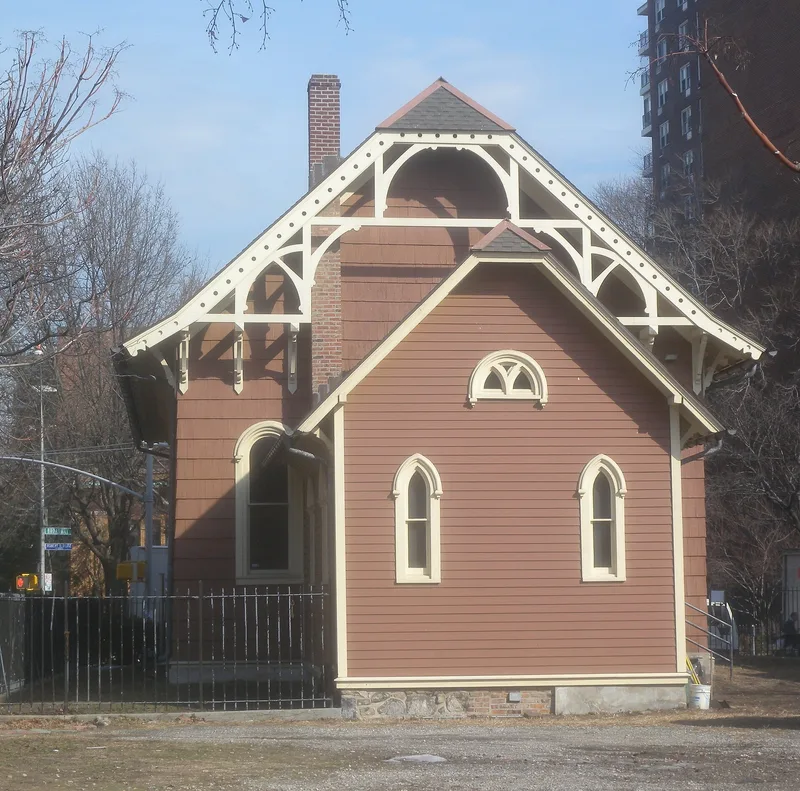
Built in 1735-36 at what is now 86-02 Broadway in Elmhurst, Queens, this small timber-framed building began as the Church of England mission church at Newtown. Joseph Moore, described in town records as a yeoman, built it. The nomination calls it the oldest remaining Church of England building in New York City and the only remaining vernacular one. Over time it gained two bays at the east end around 1771, a rebuilt tower in 1760, a barrel-vaulted ceiling in 1816, and major repairs after the tower collapsed in 1883. Its heavy timber frame, rectangular form and much early paneling and woodwork survive. The congregation, incorporated as St. James in 1761, held its last service here in 1848 after moving to a larger church nearby, and the building then served as a parish hall and Sunday school. It was listed for its association with colonial life and as a rare surviving colonial mission church, with significance running from 1735 to 1883.
Significance in brief: The nomination argues it is the oldest remaining Church of England building in New York City and a rare surviving vernacular colonial mission church. It is significant under Criterion A for its ties to colonial life in Newtown and under Criterion C as a distinguished example of vernacular Colonial architecture that retains its heavy timber frame and much interior woodwork.
Machine-generated summary. This summary was generated by a language model from the official nomination document and has not been reviewed line by line by an editor. It may contain errors. Check the source document before relying on any detail. Source: nomination document (PDF) · National Archives catalog entry. NRHP reference 99001331, listed November 12, 1999. Summary generated October 2026 (model claude-sonnet-5-5, prompt v1.0-2026-10-29, confidence high).
Key facts
| Address | 86-02 Broadway, Elmhurst |
|---|---|
| County | Queens |
| Listed | November 12, 1999 |
| Reference number | 99001331 |
| Resource type | Building |
| Period of significance | 1735-1883 |
| Architect / builder | Joseph Moore of Newtown |
| Architectural style | COLONIAL/Post-medieval English |
| Criteria |
|
| Areas of significance | Architecture, Religion |
| Level of significance | Local |
| Status (as stated in the nomination) | Currently used as a church-related community center (religion and social/community center functions); the congregation's services moved to a larger church in 1848 and the building then served as a parish hall and Sunday school. |
| Acreage | 0.9 |
| Coordinates | 40.73849, -73.87750 (NPS GIS) |
What listing means for this property
Religious properties are listed for their architectural or historical significance, not their religious use. Listing is honorary and does not restrict the congregation's use of the building. The federal rehabilitation credit is generally unavailable unless part of the building is income-producing; some state programmes and preservation grants do cover religious buildings. Federal funding or permits trigger Section 106 review.
General information, not legal or tax advice. Rules change; confirm with your State Historic Preservation Office or a qualified adviser.
Sources and further reading
- National Park Service, National Register of Historic Places database (snapshot May 2026), reference 99001331.
- Nomination form (PDF, National Archives) — catalog entry
- Wikipedia article (used for cross-checking only; text not reproduced here)
- Wikidata Q7588455
- This listing as JSON
Last updated October 2026. Found an error? See the editorial policy for how to report it.