Fort Totten Officers' Club

Why it's listed
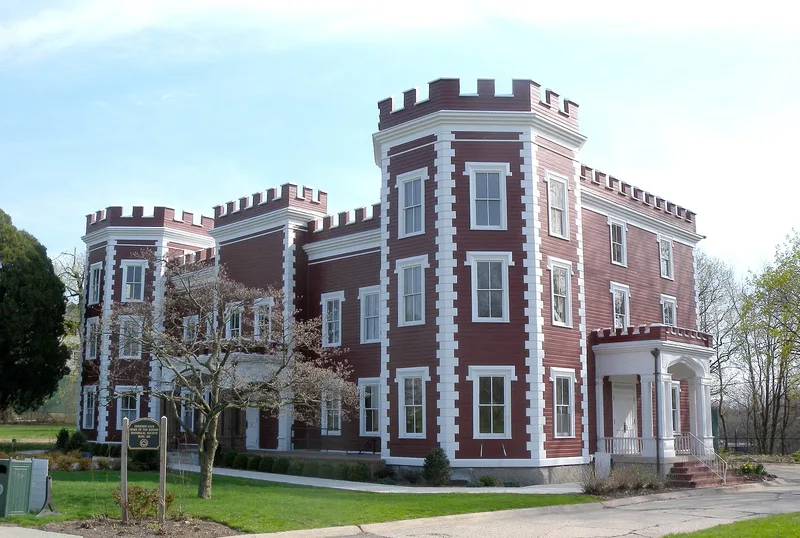
Perched within Fort Totten in Queens, this two-story wood frame building was erected in 1887 as an enlargement of a modest one-story club from the 1870s. Clapboard walls, polygonal three-story towers, crenelated battlements, ogee entrance porches and Gothic label moldings over the windows give it a castle-like look, and it was known as the casino or "the castle." The design was meant to echo the crenelated fortress in the Corps of Engineers insignia, a fitting choice because most officers at the post were military engineers and West Point graduates. The club served as the social center of the fort, hosting formal and informal gatherings, until the Army left the installation in the 1960s. It is considered one of few castellated Gothic Revival buildings left in New York City and a rare example built of wood rather than masonry. The building is vacant and in fair but deteriorating condition, and concern over its future prompted its individual nomination.
Significance in brief: The nomination argues it is an unusual, intact example of wood frame Gothic Revival institutional architecture tied to garrison life at a New York Harbor defense post. Its crenelated towers were designed to imitate the insignia of the U.S. Army Corps of Engineers. It was the social center of Fort Totten for decades and is a rare wood interpretation of a style usually built in masonry.
Machine-generated summary. This summary was generated by a language model from the official nomination document and has not been reviewed line by line by an editor. It may contain errors. Check the source document before relying on any detail. Source: nomination document (PDF) · National Archives catalog entry. NRHP reference 86000446, listed March 17, 1986. Summary generated October 2026 (model claude-sonnet-5-5, prompt v1.0-2026-10-29, confidence high).
Key facts
| Address | Totten and Murray Aves., New York |
|---|---|
| County | Queens |
| Listed | March 17, 1986 |
| Reference number | 86000446 |
| Resource type | Building |
| Period of significance | 1800-1899 (specific dates 1870/1887) |
| Architectural style | Gothic Revival (castellated) |
| Criteria |
|
| Areas of significance | Military, Architecture |
| Level of significance | Local |
| Status (as stated in the nomination) | Listed as public property, unoccupied/vacant, in fair condition but deteriorating. |
| Acreage | 1 |
| Coordinates | 40.79224, -73.77756 (NPS GIS) |
What listing means for this property
National Register listing is honorary: it recognises significance and does not restrict what a private owner may do without federal money or permits. It unlocks the 20% federal rehabilitation tax credit for income-producing buildings, state credits in many states, and Section 106 review when federal agencies are involved. See what listing means in practice.
Noted as vacant in the nomination. Nomination documents can be decades old; current status may differ. If you are considering buying an empty listed property, read the due-diligence checklist.
General information, not legal or tax advice. Rules change; confirm with your State Historic Preservation Office or a qualified adviser.
Sources and further reading
- National Park Service, National Register of Historic Places database (snapshot May 2026), reference 86000446.
- Nomination form (PDF, National Archives) — catalog entry
- Wikipedia article (used for cross-checking only; text not reproduced here)
- Wikidata Q5472192
- This listing as JSON
Last updated October 2026. Found an error? See the editorial policy for how to report it.