Sloan, George B., Estate

Why it's listed
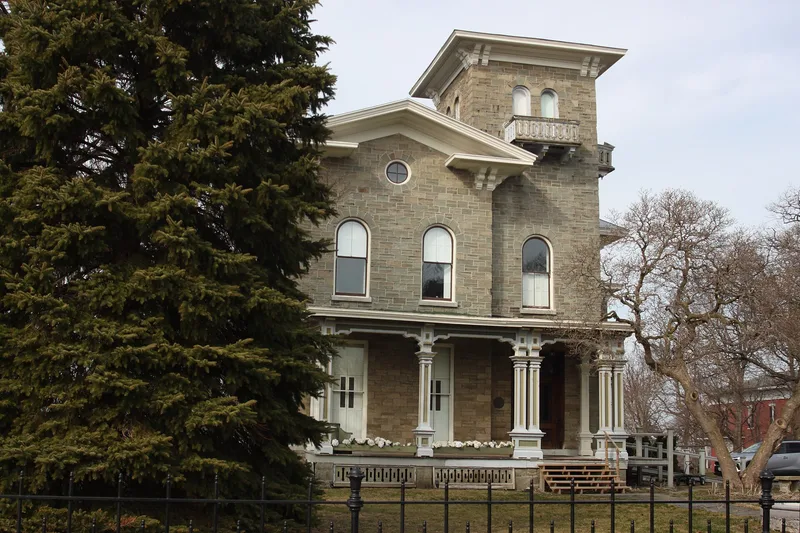
On the northeast corner of West Van Buren and West 8th streets in Oswego stands a two-and-one-half-story Italian Villa style mansion of Ithaca limestone, built between 1866 and 1870 for lumber merchant John Mott. It has a three-story engaged tower, bracketed eaves and a front porch. The 1.35-acre estate also includes a picturesque board-and-batten carriage house/barn with Stick style detailing, a cast-iron fence set on a limestone wall, and a working ornamental fountain. Inside, tiled floors, carved fireplace surrounds and a curved staircase survive, and the parlor mantel is believed to be by the Herter Brothers of New York City. George B. Sloan, a self-made grain merchant, state senator and bank president, bought the property soon after completion, and his family held it until 1933. Although the house now holds apartments, its exterior and interior remain largely intact. The estate reflects the wealth and taste of Oswego's late nineteenth century entrepreneurs.
Significance in brief: The nomination argues the property is architecturally significant as a distinguished, extremely intact Italian Villa style residence. It retains a carriage house, parts of its designed landscape and elaborate interiors, some attributed to the Herter Brothers of New York City. It is also associated with George B. Sloan, a wealthy Oswego industrialist and politician, and recalls the late nineteenth century prosperity of Oswego.
Machine-generated summary. This summary was generated by a language model from the official nomination document and has not been reviewed line by line by an editor. It may contain errors. Check the source document before relying on any detail. Source: nomination document (PDF) · National Archives catalog entry. NRHP reference 88001237, listed August 11, 1988. Summary generated October 2026 (model claude-sonnet-5-5, prompt v1.0-2026-10-29, confidence medium).
Key facts
| Address | 107 W. Van Buren St., Oswego |
|---|---|
| County | Oswego County |
| Listed | August 11, 1988 |
| Reference number | 88001237 |
| Resource type | Building |
| Period of significance | 1866-70 |
| Architectural style | Italian Villa |
| Areas of significance | Architecture |
| Level of significance | Local |
| Status (as stated in the nomination) | Occupied; the house has been converted into apartments, and its interior retains a high degree of integrity. The landscape has lost some original features such as the gates, urns and Venus statue. |
| Acreage | 1.4 |
| Coordinates | 43.45982, -76.52103 (NPS GIS) |
What listing means for this property
National Register listing is honorary for a privately owned home: it does not by itself restrict what an owner may do with their own money, and it does not require public access. Restrictions come from local landmark or historic-district ordinances, which are separate (how they differ).
Owner-occupied houses are not eligible for the 20% federal rehabilitation tax credit, which applies to income-producing buildings, but many states offer credits for homeowners. Listing also opens the door to preservation easements and to buying a plaque. Start with what listing means for homeowners, renovating a listed house and selling one.
General information, not legal or tax advice. Rules change; confirm with your State Historic Preservation Office or a qualified adviser.
Sources and further reading
- National Park Service, National Register of Historic Places database (snapshot May 2026), reference 88001237.
- Nomination form (PDF, National Archives) — catalog entry
- Wikipedia article (used for cross-checking only; text not reproduced here)
- Wikidata Q5536573
- This listing as JSON
Last updated October 2026. Found an error? See the editorial policy for how to report it.