Primitive Baptist Church of Brookfield
Also known as: Old School Baptist Church

Why it's listed
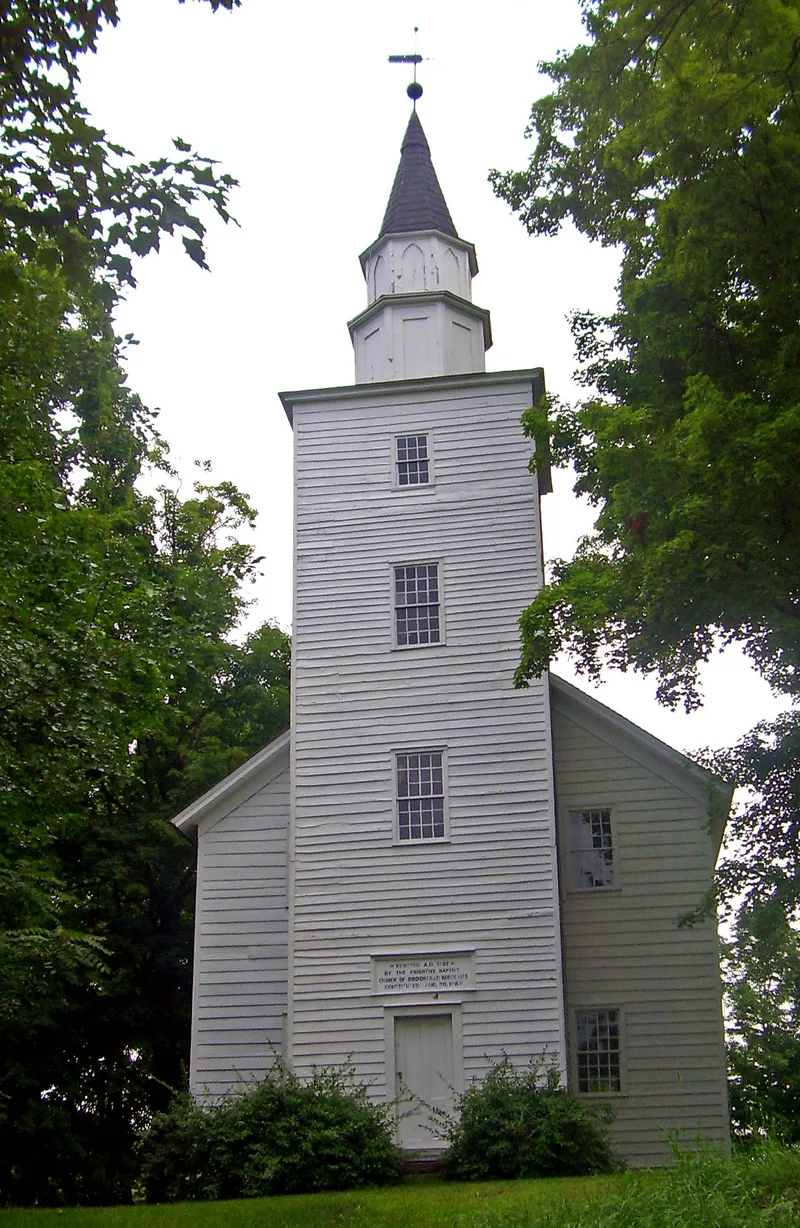
Built in 1792 on land donated by John Hallock, this two-story clapboarded meetinghouse sits on a rise at the edge of the crossroads village of Slate Hill in Orange County, New York. It served a Baptist fellowship organized as a separate congregation in 1783 and incorporated in 1791. A four-story tower with belfry and spire was added in 1828 to give the building a more up-to-date look, along with a second entrance and a relocated stairway for added seating. In 1833 the congregation rejected the evangelical trends of the Second Great Awakening and became the Old School Baptists. The interior is the main reason for its recognition: exposed heavy timber framing, box pews with raised and fielded panels, a three-sided gallery, unpainted white pine woodwork and a raised hexagonal pulpit of a type common in earlier New England churches. Although the last congregation member died in 1933, community members have kept up the required annual meeting.
Significance in brief: The church housed a Baptist congregation formed in 1783 that in 1833 returned to the conservative Primitive or Old School Baptist beliefs, rejecting the evangelical movement of the Second Great Awakening. The interior is largely unaltered, with exposed heavy timber framing, box pews and a raised hexagonal pulpit. Such a pulpit is unusual for the New York region and a late example for 1792.
Machine-generated summary. This summary was generated by a language model from the official nomination document and has not been reviewed line by line by an editor. It may contain errors. Check the source document before relying on any detail. Source: nomination document (PDF) · National Archives catalog entry. NRHP reference 76001260, listed November 13, 1976. Summary generated October 2026 (model claude-sonnet-5-5, prompt v1.0-2026-10-29, confidence high).
Key facts
| Address | NY 6, Slate Hill |
|---|---|
| County | Orange County |
| Listed | November 13, 1976 |
| Reference number | 76001260 |
| Resource type | Building |
| Period of significance | 1792 |
| Architect / builder | Unknown |
| Architectural style | Federal |
| Areas of significance | Architecture, Religion |
| Level of significance | Local |
| Status (as stated in the nomination) | Listed as occupied and in good condition, with the original site retained. The last congregation member died in 1933, but the required annual meeting continues through other community members. |
| Acreage | 1 |
| Coordinates | 41.39033, -74.47309 (NPS GIS) |
What listing means for this property
Religious properties are listed for their architectural or historical significance, not their religious use. Listing is honorary and does not restrict the congregation's use of the building. The federal rehabilitation credit is generally unavailable unless part of the building is income-producing; some state programmes and preservation grants do cover religious buildings. Federal funding or permits trigger Section 106 review.
General information, not legal or tax advice. Rules change; confirm with your State Historic Preservation Office or a qualified adviser.
Sources and further reading
- National Park Service, National Register of Historic Places database (snapshot May 2026), reference 76001260.
- Nomination form (PDF, National Archives) — catalog entry
- Wikipedia article (used for cross-checking only; text not reproduced here)
- Wikidata Q7243548
- This listing as JSON
Last updated October 2026. Found an error? See the editorial policy for how to report it.