Clark, Hulet, Farmstead

Why it's listed
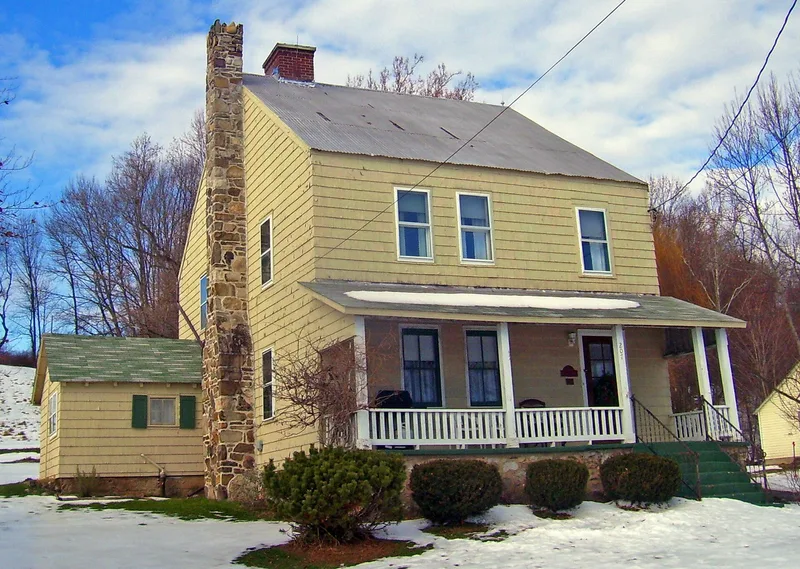
This 74-acre farmstead in Westtown, Orange County, preserves the core of a 420-acre farm that Hulet Clark bought in 1828. Clark was a militia colonel, town clerk, justice of the peace, county supervisor and judge of the Court of Common Pleas, and he ran a successful dairy farm here until his death in 1857. The property includes a c1800 two-story timber-frame farmhouse built into a hillside, with a side-passage plan, a shared interior chimney, a cooking hearth with beehive oven, and original moldings and wide plank floors. Its tall, narrow form contrasts with the long, low Dutch houses of the region and reflects English building traditions. An 1876 dairy barn, enlarged in the 1930s, and an early twentieth century chicken house record later farming. Local tradition says the house sheltered escaping slaves, but the nomination notes this is unverified. Open fields remain in use.
Significance in brief: The farmstead is tied to Hulet Clark (1790-1857), a prominent Minisink citizen who held several local government offices and ran a dairy farm. The farmhouse is an intact example of an early nineteenth century vernacular Orange County farmhouse built by English-descended settlers. The surrounding fields preserve the property's agricultural history through the late 1940s.
Machine-generated summary. This summary was generated by a language model from the official nomination document and has not been reviewed line by line by an editor. It may contain errors. Check the source document before relying on any detail. Source: nomination document (PDF) · National Archives catalog entry. NRHP reference 98001343, listed November 5, 1998. Summary generated October 2026 (model claude-sonnet-5-5, prompt v1.0-2026-10-29, confidence high).
Key facts
| Address | 207 S. Plank Rd., Westtown |
|---|---|
| County | Orange County |
| Listed | November 5, 1998 |
| Reference number | 98001343 |
| Resource type | Building |
| Period of significance | 1800-c1948 |
| Architect / builder | unknown |
| Architectural style | Early Republic |
| Criteria |
|
| Areas of significance | Architecture, Politics/Government, Agriculture |
| Level of significance | Local |
| Status (as stated in the nomination) | Farmhouse remains a dwelling; the chicken house is now a garage; fields have been leased to neighboring farmers since the 1960s and remain in active use. |
| Acreage | 74 |
| Coordinates | 41.35777, -74.54279 (NPS GIS) |
What listing means for this property
National Register listing is honorary for a privately owned home: it does not by itself restrict what an owner may do with their own money, and it does not require public access. Restrictions come from local landmark or historic-district ordinances, which are separate (how they differ).
Owner-occupied houses are not eligible for the 20% federal rehabilitation tax credit, which applies to income-producing buildings, but many states offer credits for homeowners. Listing also opens the door to preservation easements and to buying a plaque. Start with what listing means for homeowners, renovating a listed house and selling one.
General information, not legal or tax advice. Rules change; confirm with your State Historic Preservation Office or a qualified adviser.
Sources and further reading
- National Park Service, National Register of Historic Places database (snapshot May 2026), reference 98001343.
- Nomination form (PDF, National Archives) — catalog entry
- Wikipedia article (used for cross-checking only; text not reproduced here)
- Wikidata Q5935638
- This listing as JSON
Last updated October 2026. Found an error? See the editorial policy for how to report it.