East Bloomfield Historic District

Why it's listed
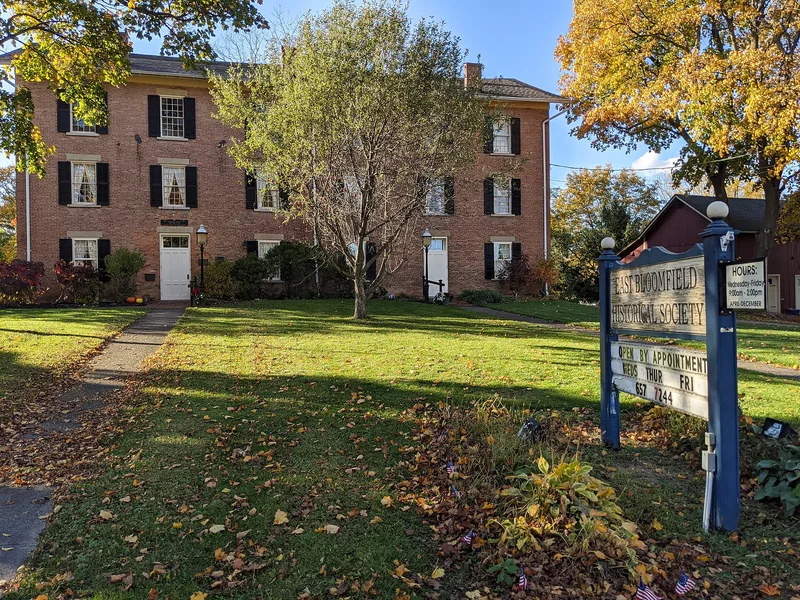
East Bloomfield's historic core is a district of 49 primary properties spread over about 46 acres in a small rural village in west-central Ontario County, New York. Its residences, churches, shops, civic buildings, village green and cemetery grew up along the Great Western Turnpike and around two centers: the commercial crossing now marked by Pickle Park, and the green near State Street. Early buildings, mostly frame or brick in the Federal and Greek Revival styles, reflect New England traditions brought by the first settlers. Notable examples include two 1830s frame churches, the brick East Bloomfield Academy of 1838, a former town hall of about 1845, and a Civil War memorial dedicated in 1868. Later Italianate, Stick and Queen Anne houses stand toward the district edges. The village once supported carriage makers, a drill factory and hop farming. The district was listed because so much of this nineteenth-century fabric survives with little intrusion.
Significance in brief: The district preserves most of the village's historic core, with Federal, Greek Revival, Italianate, Stick and Queen Anne buildings that retain high integrity. It reflects the village's growth along the Great Western Turnpike and its commercial, religious, educational and agricultural development. Key resources include the East Bloomfield Academy, early churches, a village green with a Civil War memorial, and an early cemetery.
Machine-generated summary. This summary was generated by a language model from the official nomination document and has not been reviewed line by line by an editor. It may contain errors. Check the source document before relying on any detail. Source: nomination document (PDF) · National Archives catalog entry. NRHP reference 89001947, listed November 13, 1989. Summary generated October 2026 (model claude-sonnet-5-5, prompt v1.0-2026-10-29, confidence medium).
Key facts
| Address | Roughly Main, South, Park Sts. and NY 5, East Bloomfield |
|---|---|
| County | Ontario County |
| Listed | November 13, 1989 |
| Reference number | 89001947 |
| Resource type | District |
| Architectural style | Federal, Greek Revival, Gothic Revival, Italianate, Queen Anne, Stick/Eastlake, Colonial Revival |
| Areas of significance | Community Planning and Development, Landscape Architecture, Commerce, Art, Agriculture, Education, Exploration/Settlement, Politics/Government, Architecture |
| Level of significance | Local |
| Status (as stated in the nomination) | Most buildings retain high integrity and the district has no non-contributing primary resources. The Academy building now houses a historical society museum, and residential, religious and commercial uses continue. |
| Acreage | 46 |
| Coordinates | 42.89579, -77.43378 (NPS GIS) |
What listing means for this property
This is a historic district. Buildings within its boundary are either contributing (they add to the district's significance) or non-contributing. Owners of contributing income-producing buildings can claim the 20% federal rehabilitation tax credit; homeowners should look at state credits. National Register districts impose no design review by themselves; a local historic district ordinance, if one exists, does (the difference explained).
General information, not legal or tax advice. Rules change; confirm with your State Historic Preservation Office or a qualified adviser.
Sources and further reading
- National Park Service, National Register of Historic Places database (snapshot May 2026), reference 89001947.
- Nomination form (PDF, National Archives) — catalog entry
- Wikipedia article (used for cross-checking only; text not reproduced here)
- Wikidata Q5327884
- This listing as JSON
Last updated October 2026. Found an error? See the editorial policy for how to report it.