Oswego-Oneida Streets Historic District

Why it's listed
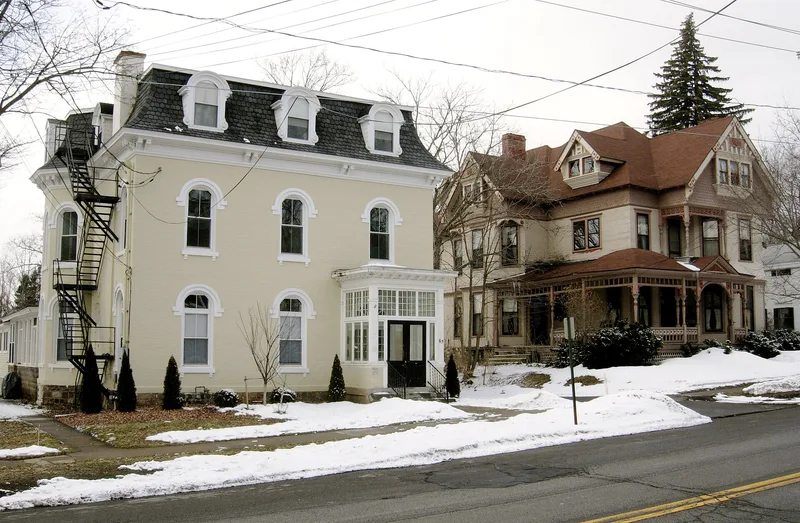
This residential neighborhood on the hill north of Baldwinsville's business district overlooks the Seneca River. Its roughly 50 acres hold 34 houses, a church and a parish hall, built from the 1820s into the early twentieth century. By the mid-1880s the area had become the village's elite residential section, home to bankers, mill and company owners, merchants, legislators and professionals. The houses show Greek Revival, Italianate, Queen Anne, Shingle, Second Empire and Tudor Revival designs, many of them local versions of popular styles. Two buildings came from well-known central New York architects: the Gothic Revival First Presbyterian Church of 1865 by Horatio Nelson White, and the Tudor Revival house called Applecrest of 1924 by Ward Wellington Ward. Residents included Judge Otis Bigelow and his banking sons, and the historian and archaeologist William Beauchamp. The district was listed as the best concentration of fine nineteenth and early twentieth century buildings in the village, with only three intrusions.
Significance in brief: The district is argued to be a significant collection of nineteenth-century architectural styles in central New York and the home of many of Baldwinsville's prominent citizens. Most houses are local interpretations of popular styles, and two buildings were designed by regional architects Horatio Nelson White and Ward Wellington Ward. It remains intact and cohesive in scale, materials and setting.
Machine-generated summary. This summary was generated by a language model from the official nomination document and has not been reviewed line by line by an editor. It may contain errors. Check the source document before relying on any detail. Source: nomination document (PDF) · National Archives catalog entry. NRHP reference 82003390, listed July 29, 1982. Summary generated October 2026 (model claude-sonnet-5-5, prompt v1.0-2026-10-29, confidence medium).
Key facts
| Address | Oswego, East and West Sts., and Sunset Terr., Baldwinsville |
|---|---|
| County | Onondaga County |
| Listed | July 29, 1982 |
| Reference number | 82003390 |
| Resource type | District |
| Period of significance | 1830-1920 |
| Architect / builder | Various; including Horatio Nelson White (First Presbyterian Church, 1865), H. M. Stephenson, and Ward Wellington Ward (14 Sunset Terrace, 1924) |
| Architectural style | Greek Revival, Gothic Revival, Italianate, Queen Anne, Shingle, Second Empire and Tudor Revival |
| Areas of significance | Architecture |
| Level of significance | Local |
| Status (as stated in the nomination) | Described as occupied, mainly private residences with a church; three intrusions noted; interiors of many homes intact and well maintained. |
| Acreage | 50 |
| Coordinates | 43.16094, -76.33454 (NPS GIS) |
What listing means for this property
This is a historic district. Buildings within its boundary are either contributing (they add to the district's significance) or non-contributing. Owners of contributing income-producing buildings can claim the 20% federal rehabilitation tax credit; homeowners should look at state credits. National Register districts impose no design review by themselves; a local historic district ordinance, if one exists, does (the difference explained).
General information, not legal or tax advice. Rules change; confirm with your State Historic Preservation Office or a qualified adviser.
Sources and further reading
- National Park Service, National Register of Historic Places database (snapshot May 2026), reference 82003390.
- Nomination form (PDF, National Archives) — catalog entry
- Wikipedia article (used for cross-checking only; text not reproduced here)
- Wikidata Q7108217
- This listing as JSON
Last updated October 2026. Found an error? See the editorial policy for how to report it.