Root, Elihu, House
Also known as: Grant House

Why it's listed
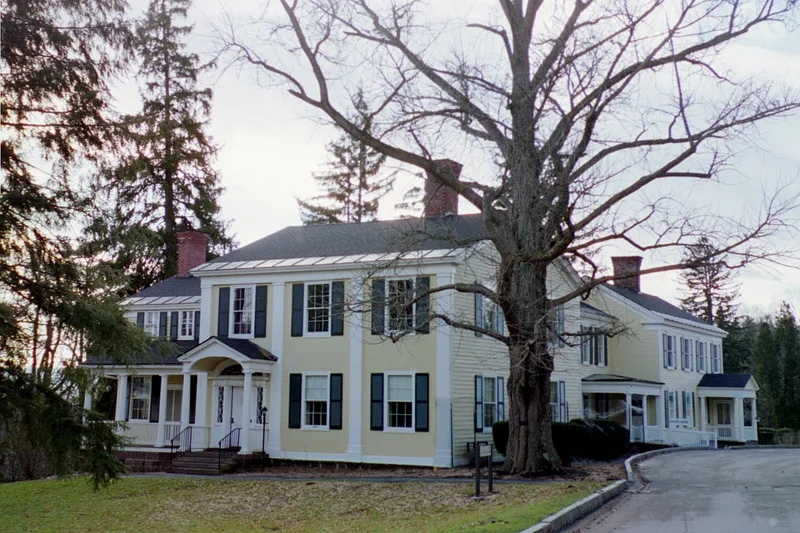
This yellow clapboard house on College Hill Road in Clinton, New York, faces the entrance to Hamilton College. Its core was built in 1817 for Theodore Strong, the college's first Professor of Mathematics, and it later served as a boardinghouse, gaining a rear dormitory wing. Elihu Root, born nearby in 1845, bought it in 1893 with four acres and made it his permanent home. In the early 1900s he removed Victorian porches in favor of ones suited to the house's Federal simplicity, and he added a large living room, a pedimented portico and servants' quarters. Root served as Secretary of War and Secretary of State under Theodore Roosevelt, reorganized the army, helped create the Army War College, and received the 1912 Nobel Peace Prize. He retired to Clinton and died there in 1937. The house still holds much of his furniture and remains in excellent condition, near the Root Glen gardens.
Significance in brief: It was the permanent home of Elihu Root, who bought it in 1893 and is called "the father of the modern American army." Root was Secretary of War and Secretary of State under Roosevelt, won the Nobel Peace Prize in 1912, and was a leading conservative voice. The house sits near his birthplace and boyhood home, and it keeps furnishings from his lifetime.
Machine-generated summary. This summary was generated by a language model from the official nomination document and has not been reviewed line by line by an editor. It may contain errors. Check the source document before relying on any detail. Source: nomination document (PDF) · National Archives catalog entry. NRHP reference 72000893, listed November 28, 1972. Summary generated October 2026 (model claude-sonnet-5-5, prompt v1.0-2026-10-29, confidence high).
Key facts
| Address | 101 College Hill Rd., Clinton |
|---|---|
| County | Oneida County |
| Listed | November 28, 1972 |
| Reference number | 72000893 |
| Resource type | Building |
| Period of significance | 1893-1937 |
| Architectural style | Federal |
| Areas of significance | Military, Politics/Government |
| Level of significance | National |
| National Historic Landmark | Yes, designated November 28, 1972 |
| Status (as stated in the nomination) | Described as in excellent condition and unaltered, on its original site, and maintained as a part-time private residence by Root's descendants. |
| Acreage | 7 |
| Coordinates | 43.04861, -75.40465 (NPS GIS) |
What listing means for this property
National Register listing is honorary for a privately owned home: it does not by itself restrict what an owner may do with their own money, and it does not require public access. Restrictions come from local landmark or historic-district ordinances, which are separate (how they differ).
Owner-occupied houses are not eligible for the 20% federal rehabilitation tax credit, which applies to income-producing buildings, but many states offer credits for homeowners. Listing also opens the door to preservation easements and to buying a plaque. Start with what listing means for homeowners, renovating a listed house and selling one.
General information, not legal or tax advice. Rules change; confirm with your State Historic Preservation Office or a qualified adviser.
Sources and further reading
- National Park Service, National Register of Historic Places database (snapshot May 2026), reference 72000893.
- Nomination form (PDF, National Archives) — catalog entry
- Wikipedia article (used for cross-checking only; text not reproduced here)
- Wikidata Q5360860
- This listing as JSON
Last updated October 2026. Found an error? See the editorial policy for how to report it.