Jericho Friends Meeting House Complex

Why it's listed
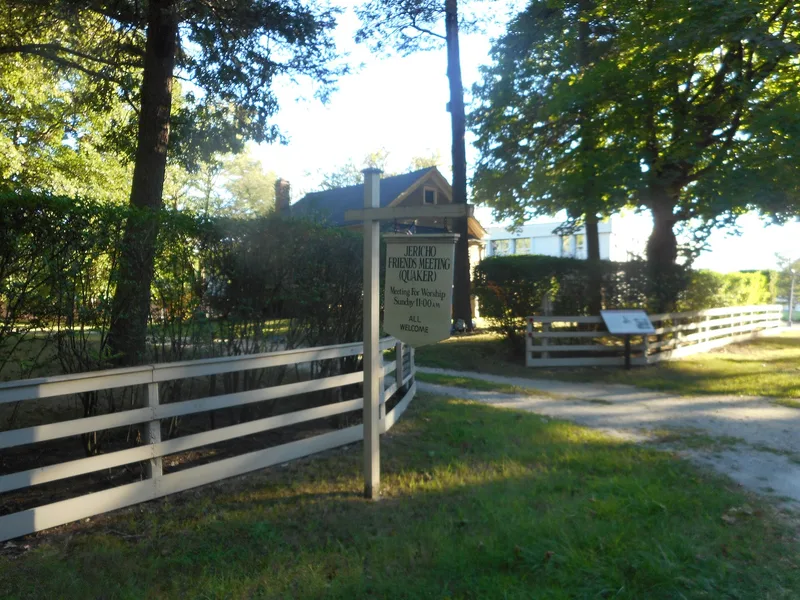
Jericho's Quaker meeting complex sits on about 3.5 acres between the original and the modern Jericho Turnpike. Its centerpiece is a two-story, shingled, timber-frame meeting house completed in 1788, joined by an 1793 schoolhouse, a broad gabled shed with hand-hewn framing, and a burial ground with plain, low markers. Inside, the building is divided into men's and women's halves, with movable panels that open the two sides together for worship. Benches, galleries and trim are simply crafted, and wood stoves remain the only heat. A porch was added in 1818 and a porte cochere in the early twentieth century, but little else has changed. The complex was listed for its architecture, which reflects New England building practice and Quaker plainness, and for its link to Elias Hicks, a Jericho Friend who spoke and wrote against slavery and became a leading figure in the Hicksite branch of the Society of Friends. Its grassy grounds and mature trees preserve a rural feel amid heavy development.
Significance in brief: The nomination argues the complex is a highly intact example of late 18th-century New England timber-frame building traditions and Quaker ideals of simplicity. The meeting house has been little altered in over two hundred years of use. It was also the home meeting of Elias Hicks, a prominent Quaker minister and opponent of slavery.
Machine-generated summary. This summary was generated by a language model from the official nomination document and has not been reviewed line by line by an editor. It may contain errors. Check the source document before relying on any detail. Source: nomination document (PDF) · National Archives catalog entry. NRHP reference 02000473, listed May 10, 2002. Summary generated October 2026 (model claude-sonnet-5-5, prompt v1.0-2026-10-29, confidence high).
Key facts
| Address | 6 Old Jericho Turnpike, Jericho |
|---|---|
| County | Nassau County |
| Listed | May 10, 2002 |
| Reference number | 02000473 |
| Resource type | Building |
| Period of significance | 1788-c1875 |
| Criteria |
|
| Areas of significance | Architecture, Social History |
| Level of significance | Local |
| Status (as stated in the nomination) | Still in religious use as a meeting house and cemetery; the schoolhouse has been converted to a caretaker's residence. |
| Acreage | 3.3 |
| Coordinates | 40.79448, -73.53627 (NPS GIS) |
What listing means for this property
Religious properties are listed for their architectural or historical significance, not their religious use. Listing is honorary and does not restrict the congregation's use of the building. The federal rehabilitation credit is generally unavailable unless part of the building is income-producing; some state programmes and preservation grants do cover religious buildings. Federal funding or permits trigger Section 106 review.
General information, not legal or tax advice. Rules change; confirm with your State Historic Preservation Office or a qualified adviser.
Sources and further reading
- National Park Service, National Register of Historic Places database (snapshot May 2026), reference 02000473.
- Nomination form (PDF, National Archives) — catalog entry
- Wikipedia article (used for cross-checking only; text not reproduced here)
- Wikidata Q6182159
- This listing as JSON
Last updated October 2026. Found an error? See the editorial policy for how to report it.