Minton's Playhouse

Why it's listed
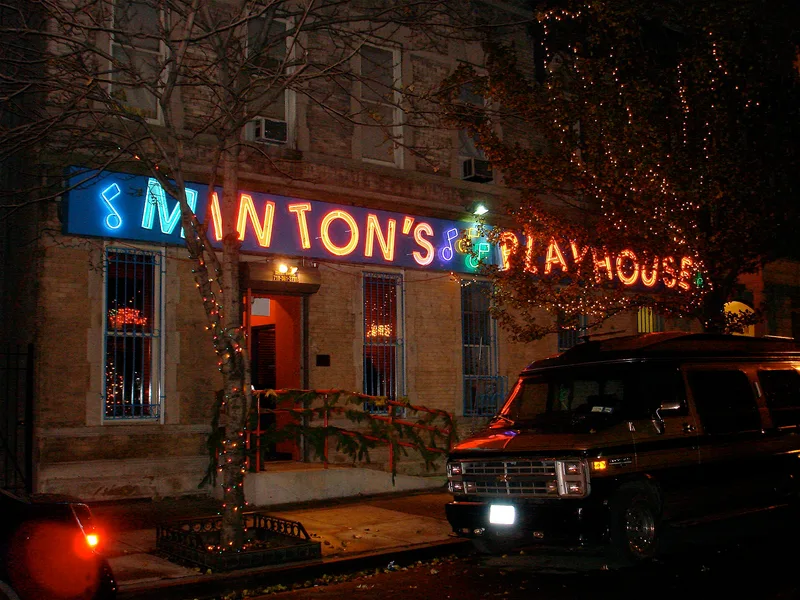
Minton's Playhouse is a small jazz club in the ground floor of the Cecil Hotel, a five-story gray brick building with limestone trim at West 118th Street and St. Nicholas Avenue in Harlem. The hotel dates from 1895 and follows the Second Renaissance Revival style. In 1939 owner Henry Minton converted a dining room into a club. The L-shaped room kept its small stage, a 38-foot hardwood bar, some booths and a 1948 mural of musicians. Through the 1940s the club hosted regular jam sessions. Drummer Kenny Clarke led the house band, and players including Thelonious Monk, Dizzy Gillespie and Charlie Christian worked out the harmonic, melodic and rhythmic ideas that became bebop. Musicians called it the music they were playing up at Minton's. The site was recognized for this role in changing the course of American jazz. The club interior is deteriorated, and the property was listed as vacant.
Significance in brief: The nomination argues that Minton's was the principal site of the jam sessions and experiments in the 1940s that led to the bebop revolution in jazz. Musicians such as Kenny Clarke, Thelonious Monk, Dizzy Gillespie and Charlie Christian developed the style there. Bebop is presented as a turning point in which jazz came to be seen as a serious art form.
Machine-generated summary. This summary was generated by a language model from the official nomination document and has not been reviewed line by line by an editor. It may contain errors. Check the source document before relying on any detail. Source: nomination document (PDF) · National Archives catalog entry. NRHP reference 85002423, listed September 18, 1985. Summary generated October 2026 (model claude-sonnet-5-5, prompt v1.0-2026-10-29, confidence medium).
Key facts
| Address | 206--210 W. One Hundred Eighteenth St., New York |
|---|---|
| County | Manhattan |
| Listed | September 18, 1985 |
| Reference number | 85002423 |
| Resource type | Building |
| Period of significance | 1939-1949 |
| Architectural style | Second Renaissance Revival |
| Areas of significance | Performing Arts |
| Level of significance | National |
| Status (as stated in the nomination) | The form lists the property as unoccupied and vacant. The club interior is deteriorated but restorable, and a beauty shop and laundry were noted on the St. Nicholas Avenue side. |
| Acreage | 0.9 |
| Coordinates | 40.80477, -73.95278 (NPS GIS) |
What listing means for this property
National Register listing is honorary: it recognises significance and does not restrict what a private owner may do without federal money or permits. It unlocks the 20% federal rehabilitation tax credit for income-producing buildings, state credits in many states, and Section 106 review when federal agencies are involved. See what listing means in practice.
Noted as vacant in the nomination. Nomination documents can be decades old; current status may differ. If you are considering buying an empty listed property, read the due-diligence checklist.
General information, not legal or tax advice. Rules change; confirm with your State Historic Preservation Office or a qualified adviser.
Sources and further reading
- National Park Service, National Register of Historic Places database (snapshot May 2026), reference 85002423.
- Nomination form (PDF, National Archives) — catalog entry
- Wikipedia article (used for cross-checking only; text not reproduced here)
- Wikidata Q1814151
- This listing as JSON
Last updated October 2026. Found an error? See the editorial policy for how to report it.