Johnson, James Weldon, House

Why it's listed
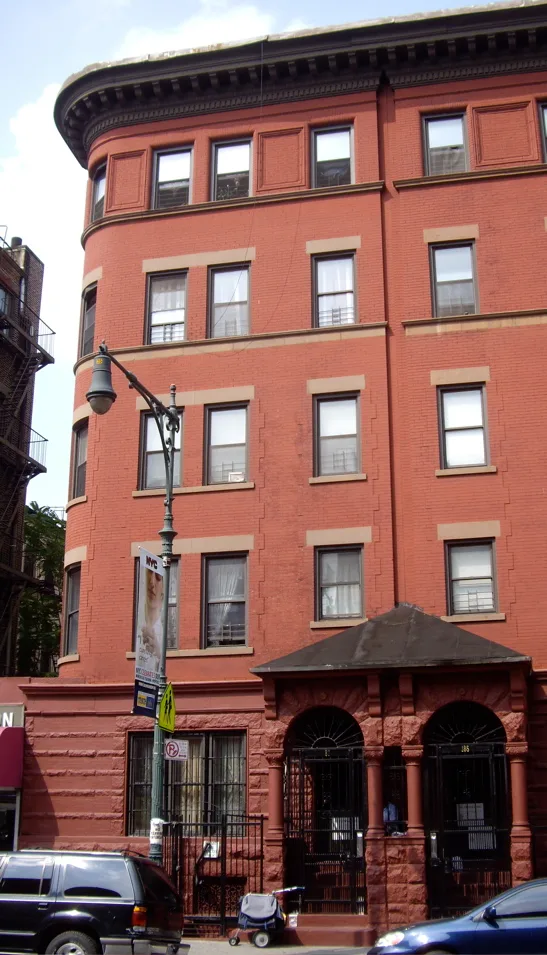
This five-story apartment building at 185-187 West 135th Street in Harlem was the home of James Weldon Johnson for a little more than thirteen years, from 1925 to 1938, while he headed the NAACP. Built in the early twentieth century, it has red face brick above a rusticated stone first floor, an entrance porch carried on four marble columns with round arches, and a projecting metal cornice on modillions. Its plan resembles a dumbbell, with a side light court. Johnson, born in Jacksonville, Florida in 1871, was a school principal, lawyer, newspaper founder, songwriter, diplomat and author. With his brother Rosamond he wrote "Lift Every Voice and Sing," later known as the Negro National Hymn. At the NAACP he organized branches, backed the Silent Protest Parade, petitioned President Wilson for clemency for convicted soldiers, lobbied for an anti-lynching bill and investigated conditions in Haiti. The nomination recognizes the building as his residence.
Significance in brief: The building is nominated for its association with James Weldon Johnson, who lived there while leading the NAACP as its national executive officer. Johnson was a writer, songwriter, educator, diplomat and civil rights leader, known for "Lift Every Voice and Sing" and his campaigns for racial equality. The form places it under Afro-American history and social/humanitarian significance.
Machine-generated summary. This summary was generated by a language model from the official nomination document and has not been reviewed line by line by an editor. It may contain errors. Check the source document before relying on any detail. Source: nomination document (PDF) · National Archives catalog entry. NRHP reference 76001241, listed May 11, 1976. Summary generated October 2026 (model claude-sonnet-5-5, prompt v1.0-2026-10-29, confidence medium).
Key facts
| Address | 187 W. 135th St., New York |
|---|---|
| County | Manhattan |
| Listed | May 11, 1976 |
| Reference number | 76001241 |
| Resource type | Building |
| Period of significance | 1925-1938 |
| Architectural style | Romanesque rusticated stone first floor with Italian Renaissance details above |
| Areas of significance | Black, Education, Politics/Government, Social History, Performing Arts |
| Level of significance | National |
| National Historic Landmark | Yes, designated May 11, 1976 |
| Status (as stated in the nomination) | Occupied as an apartment building; structure appears sound but needs architectural repairs, and the brickwork needs cleaning and painting. |
| Acreage | 0.9 |
| Within district | Central Harlem North Historic District |
| Coordinates | 40.81527, -73.94302 (NPS GIS) |
What listing means for this property
National Register listing is honorary for a privately owned home: it does not by itself restrict what an owner may do with their own money, and it does not require public access. Restrictions come from local landmark or historic-district ordinances, which are separate (how they differ).
Owner-occupied houses are not eligible for the 20% federal rehabilitation tax credit, which applies to income-producing buildings, but many states offer credits for homeowners. Listing also opens the door to preservation easements and to buying a plaque. Start with what listing means for homeowners, renovating a listed house and selling one.
General information, not legal or tax advice. Rules change; confirm with your State Historic Preservation Office or a qualified adviser.
Sources and further reading
- National Park Service, National Register of Historic Places database (snapshot May 2026), reference 76001241.
- Nomination form (PDF, National Archives) — catalog entry
- Wikipedia article (used for cross-checking only; text not reproduced here)
- Wikidata Q6145294
- This listing as JSON
Last updated October 2026. Found an error? See the editorial policy for how to report it.