Henson, Matthew, Residence
Also known as: See Also:Dunbar Apartments

Why it's listed
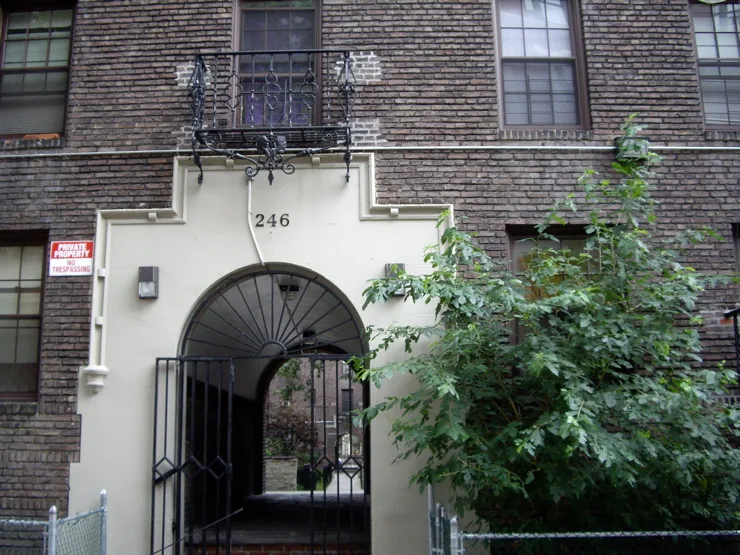
Apartment 3F in the Dunbar Apartments, at 246 W. 150th Street in Harlem, was the home of explorer Matthew Henson for the last decades of his life, from the late 1920s until his death in 1955. The Dunbar complex, built between 1926 and 1928 and designed by Andrew J. Thomas, was the first large cooperative built for Black residents and Manhattan's earliest large garden apartment complex. Its six U-shaped buildings, holding 511 apartments, surround a landscaped court. Henson, born in Maryland in 1866, accompanied Robert Peary on seven Arctic expeditions and was the last man selected to go the final stretch to the North Pole in 1909. He was valued for his sledge building, dog driving and command of the Inuit language. Recognition came late, including honors from presidents Truman and Eisenhower. A plaque at the Seventh Avenue entrance marks his residence. A review committee singled out Apartment 3F as the landmark.
Significance in brief: The nomination argues that Matthew Henson, a Black American explorer, was among the first known people to reach the North Pole with Robert Peary in 1909. He lived at the Dunbar Apartments from 1928 or 1929 until his death in 1955. The complex was also the first large cooperative built for Black residents and housed many prominent Black figures. The consulting committee decided that Apartment 3F alone should be the landmark.
Machine-generated summary. This summary was generated by a language model from the official nomination document and has not been reviewed line by line by an editor. It may contain errors. Check the source document before relying on any detail. Source: nomination document (PDF) · National Archives catalog entry. NRHP reference 75001207, listed May 15, 1975. Summary generated October 2026 (model claude-sonnet-5-5, prompt v1.0-2026-10-29, confidence medium).
Key facts
| Address | 246 W. 150th St., Apt. 3F, New York |
|---|---|
| County | Manhattan |
| Listed | May 15, 1975 |
| Reference number | 75001207 |
| Resource type | Building |
| Period of significance | 1866-1955 (Henson) |
| Architect / builder | Andrew J. Thomas (designer of the Dunbar Apartments) |
| Areas of significance | Black, Science, Architecture |
| Level of significance | National |
| National Historic Landmark | Yes, designated May 15, 1975 |
| Status (as stated in the nomination) | Listed in good condition, unaltered and on its original site; the present use is given as a private residence. The Dunbar complex is an official New York City Landmark (1970). |
| Acreage | 0.9 |
| Coordinates | 40.82543, -73.93880 (NPS GIS) |
What listing means for this property
National Register listing is honorary for a privately owned home: it does not by itself restrict what an owner may do with their own money, and it does not require public access. Restrictions come from local landmark or historic-district ordinances, which are separate (how they differ).
Owner-occupied houses are not eligible for the 20% federal rehabilitation tax credit, which applies to income-producing buildings, but many states offer credits for homeowners. Listing also opens the door to preservation easements and to buying a plaque. Start with what listing means for homeowners, renovating a listed house and selling one.
General information, not legal or tax advice. Rules change; confirm with your State Historic Preservation Office or a qualified adviser.
Sources and further reading
- National Park Service, National Register of Historic Places database (snapshot May 2026), reference 75001207.
- Nomination form (PDF, National Archives) — catalog entry
- Wikipedia article (used for cross-checking only; text not reproduced here)
- Wikidata Q6790666
- This listing as JSON
Last updated October 2026. Found an error? See the editorial policy for how to report it.