Dexter Universalist Church

Why it's listed
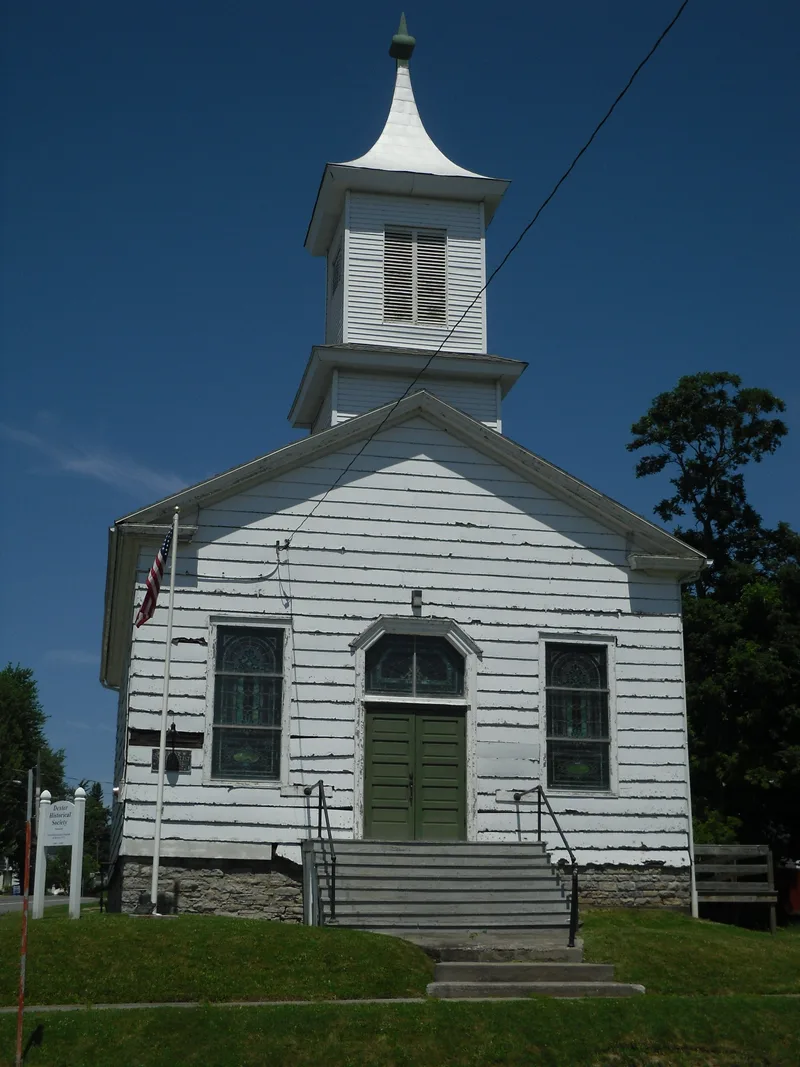
Built in 1841 for $1500, this small Greek Revival church sits at the corner of Brown and Kirby Streets in the Village of Dexter, Jefferson County. It is a single-story wood-frame building with a one-room plan, a steep front gable, cornice returns, a two-tiered steeple holding the church bell, and a cut stone foundation of local Chaumont limestone. A three-sided chancel was added in 1882, stained glass windows and oak pews replaced earlier fittings, and the church was rededicated in 1893. Later changes include masonite siding in 1976, though the original clapboard survives beneath it. The First Universalist Society of Dexter began with 25 members and held services from December 1841 until October 1997, when declining membership forced the congregation to disband. The church was listed for its architecture and its role in community life, as a rural village religious property with a largely intact interior and center-aisle plan. It was donated in 1998 to a non-profit housing organization.
Significance in brief: The nomination finds the church significant in architecture as a modest, largely intact Greek Revival church with its original center-aisle plan, interior finishes and pews. It is also significant in social history for its role in community life for 156 years and as a religious property in the Rural Village context of the Fort Drum area. It represents a Universalist congregation that is described as under-represented in accounts of local development.
Machine-generated summary. This summary was generated by a language model from the official nomination document and has not been reviewed line by line by an editor. It may contain errors. Check the source document before relying on any detail. Source: nomination document (PDF) · National Archives catalog entry. NRHP reference 03000249, listed September 19, 2003. Summary generated October 2026 (model claude-sonnet-5-5, prompt v1.0-2026-10-29, confidence high).
Key facts
| Address | Brown and Kirby Sts., Dexter |
|---|---|
| County | Jefferson County |
| Listed | September 19, 2003 |
| Reference number | 03000249 |
| Resource type | Building |
| Period of significance | 1841-1952 |
| Architectural style | Greek Revival |
| Criteria |
|
| Areas of significance | Architecture, Social History |
| Level of significance | Local |
| Status (as stated in the nomination) | The congregation disbanded in 1997 and the church was donated in 1998 to a non-profit housing organization, which planned restoration into a museum. The form lists its current function as vacant. |
| Acreage | 0.9 |
| Coordinates | 44.00806, -76.04425 (NPS GIS) |
What listing means for this property
Religious properties are listed for their architectural or historical significance, not their religious use. Listing is honorary and does not restrict the congregation's use of the building. The federal rehabilitation credit is generally unavailable unless part of the building is income-producing; some state programmes and preservation grants do cover religious buildings. Federal funding or permits trigger Section 106 review.
Noted as vacant in the nomination. Nomination documents can be decades old; current status may differ. If you are considering buying an empty listed property, read the due-diligence checklist.
General information, not legal or tax advice. Rules change; confirm with your State Historic Preservation Office or a qualified adviser.
Sources and further reading
- National Park Service, National Register of Historic Places database (snapshot May 2026), reference 03000249.
- Nomination form (PDF, National Archives) — catalog entry
- Wikipedia article (used for cross-checking only; text not reproduced here)
- Wikidata Q14706238
- This listing as JSON
Last updated October 2026. Found an error? See the editorial policy for how to report it.