Snells Bush Church and Cemetery
Also known as: St. Paul's Dutch Reformed Church

Why it's listed
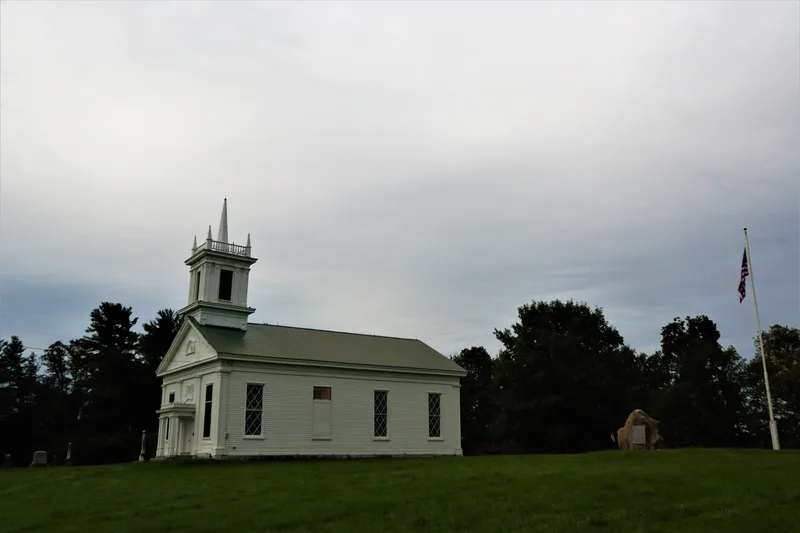
Snells Bush Church and Cemetery occupy a hilltop above the Mohawk Valley in Manheim, Herkimer County. The timber-framed church, 60 by 40 feet, was built in 1850 for a Dutch Reformed congregation first formed about 1757 and is the third house of worship on the site. Builder Lewis Perrine gave it vernacular Greek Revival details, including Tuscan pilasters, a pedimented front with paired columns at the entrance, and a two-stage belfry. Inside are a gallery, original boxed pews and stained glass salvaged from a demolished Lutheran church. The cemetery holds about 345 burials, among them 11 Revolutionary War soldiers, six of whom fought at Oriskany. The property reflects the settlement of the area by Palatine German families. After services ended in 1924, a campaign by descendants in 1938 prevented demolition, and a family reunion organization has maintained the site since 1942, holding an annual service.
Significance in brief: The nomination argues the property is tied to the earliest European settlement of Manheim by Palatine German families, and that the church is a highly intact example of vernacular Greek Revival church architecture in rural Herkimer County. The cemetery is significant for its 18th and 19th century funerary art and for the graves of 11 Revolutionary War veterans, including six who fought at Oriskany.
Machine-generated summary. This summary was generated by a language model from the official nomination document and has not been reviewed line by line by an editor. It may contain errors. Check the source document before relying on any detail. Source: nomination document (PDF) · National Archives catalog entry. NRHP reference 04000092, listed February 26, 2004. Summary generated October 2026 (model claude-sonnet-5-5, prompt v1.0-2026-10-29, confidence high).
Key facts
| Address | Snells Bush Rd., Manheim |
|---|---|
| County | Herkimer County |
| Listed | February 26, 2004 |
| Reference number | 04000092 |
| Resource type | Building |
| Period of significance | ca. 1757-1938 |
| Architect / builder | Lewis Perrine (builder) |
| Architectural style | Mid-19th Century Revivals/Greek Revival |
| Criteria |
|
| Areas of significance | Exploration/Settlement, Architecture |
| Level of significance | Local |
| Status (as stated in the nomination) | Still used for religious purposes; the congregation's descendants hold an annual summer worship service. The church closed in 1924 and was threatened with demolition in 1938 before a descendants' group took over its upkeep. A metal roof was installed in 2000. |
| Acreage | 5.5 |
| Coordinates | 43.03835, -74.77341 (NPS GIS) |
What listing means for this property
Religious properties are listed for their architectural or historical significance, not their religious use. Listing is honorary and does not restrict the congregation's use of the building. The federal rehabilitation credit is generally unavailable unless part of the building is income-producing; some state programmes and preservation grants do cover religious buildings. Federal funding or permits trigger Section 106 review.
General information, not legal or tax advice. Rules change; confirm with your State Historic Preservation Office or a qualified adviser.
Sources and further reading
- National Park Service, National Register of Historic Places database (snapshot May 2026), reference 04000092.
- Nomination form (PDF, National Archives) — catalog entry
- Wikipedia article (used for cross-checking only; text not reproduced here)
- Wikidata Q7547655
- This listing as JSON
Last updated October 2026. Found an error? See the editorial policy for how to report it.