Rider-Hopkins Farm and Olmsted Camp

Why it's listed
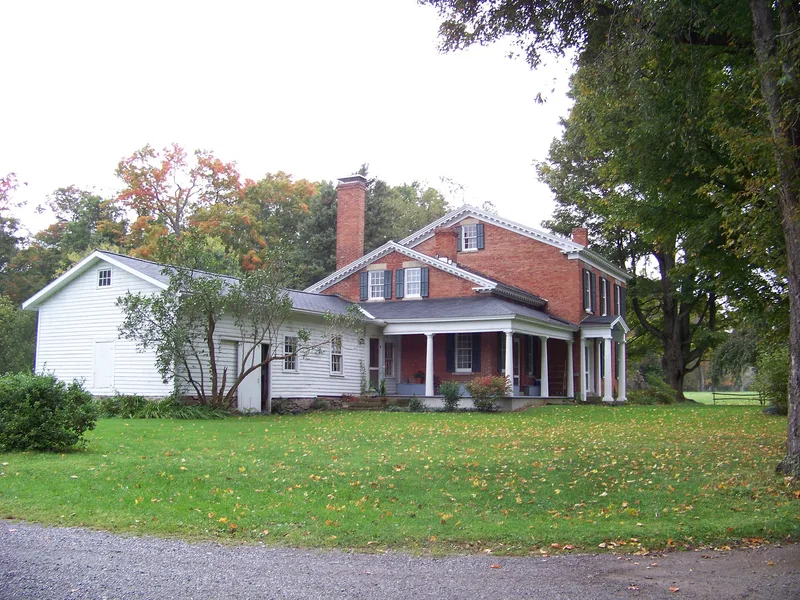
This 188.40-acre property in Sardinia, Erie County, combines a working farm with a family summer camp. Horace Rider assembled the land from the Holland Land Company in 1827 and 1828, and his son-in-law James Hopkins is believed to have built the brick farmhouse in the 1840s. The house is Greek Revival, with wooden trim adapted from Asher Benjamin's builder's manuals, and it stands among timber-framed farm outbuildings dating from the 1870s to the 1930s. In the southwest corner, the Olmsted Camp began in 1898 when a Buffalo family started leasing land there. Its five wooden Arts and Crafts buildings include a main cabin, a dormitory and three small cottages. They sit within a naturalistic lawn and flower garden laid out by Harold Olmsted, who designed the camp. The property is significant for architecture, agriculture and recreation, with a period of significance from about 1840 to 1926. The fields are still farmed and the camp is still used each summer.
Significance in brief: The nomination argues the farm is a rare surviving settlement-era Western New York farm that has kept nearly its original boundaries and is still farmed. Its brick Greek Revival farmhouse is described as one of the finest in Erie County. The Olmsted Camp is presented as an outstanding turn-of-the-century family summer retreat, with Arts and Crafts buildings and naturalistic grounds designed by Harold Olmsted.
Machine-generated summary. This summary was generated by a language model from the official nomination document and has not been reviewed line by line by an editor. It may contain errors. Check the source document before relying on any detail. Source: nomination document (PDF) · National Archives catalog entry. NRHP reference 98001613, listed January 15, 1999. Summary generated October 2026 (model claude-sonnet-5-5, prompt v1.0-2026-10-29, confidence high).
Key facts
| Address | 12820 Benton Rd., Sardinia |
|---|---|
| County | Erie County |
| Listed | January 15, 1999 |
| Reference number | 98001613 |
| Resource type | Building |
| Period of significance | ca. 1840-1926 |
| Architect / builder | Dwelling: unknown; camp: Harold L. Olmsted |
| Architectural style | Mid-Nineteenth Century/Greek Revival; Early Twentieth Century/Craftsman (camp buildings described as Arts and Crafts) |
| Criteria |
|
| Areas of significance | Architecture, Agriculture, Entertainment/Recreation |
| Level of significance | Local |
| Status (as stated in the nomination) | Farmland is still used for agriculture, with fields leased for vegetables, alfalfa and pasture. The camp continues to be used as a family summer retreat. |
| Acreage | 188.4 |
| Coordinates | 42.53168, -78.51151 (NPS GIS) |
What listing means for this property
National Register listing is honorary for a privately owned home: it does not by itself restrict what an owner may do with their own money, and it does not require public access. Restrictions come from local landmark or historic-district ordinances, which are separate (how they differ).
Owner-occupied houses are not eligible for the 20% federal rehabilitation tax credit, which applies to income-producing buildings, but many states offer credits for homeowners. Listing also opens the door to preservation easements and to buying a plaque. Start with what listing means for homeowners, renovating a listed house and selling one.
General information, not legal or tax advice. Rules change; confirm with your State Historic Preservation Office or a qualified adviser.
Sources and further reading
- National Park Service, National Register of Historic Places database (snapshot May 2026), reference 98001613.
- Nomination form (PDF, National Archives) — catalog entry
- Wikipedia article (used for cross-checking only; text not reproduced here)
- Wikidata Q7332599
- This listing as JSON
Last updated October 2026. Found an error? See the editorial policy for how to report it.