Kleinhans Music Hall
Also known as: See Also: Allentown Historic District

Why it's listed
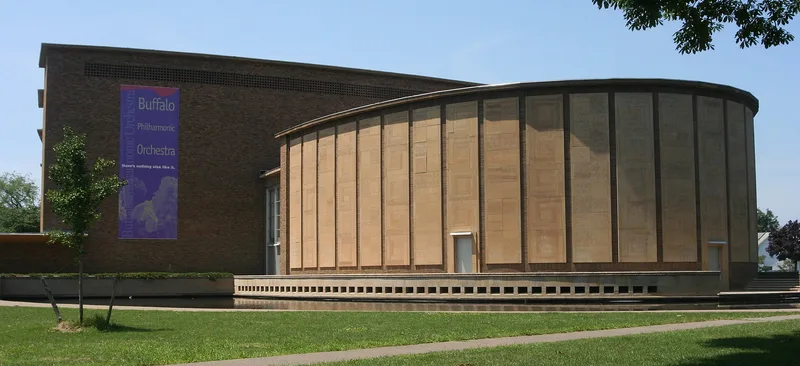
Kleinhans Music Hall is a concert hall on a triangular site at Symphony Circle in Buffalo, set on one of the landscaped circles from the Olmsted and Vaux park plan. Built between 1938 and 1940, it was designed by Eliel and Eero Saarinen, with the Buffalo firm of F.J. and W.A. Kidd supervising construction. A steel-frame building with brick and limestone walls under a flat roof, it holds a main auditorium seating about 3,000, a Chamber Music Hall for about 800, and a rehearsal room. Its form follows acoustic and lighting needs worked out with consultants Charles Potwin and Stanley McCandless. Furniture was designed by Charles Eames and Eero Saarinen. Funding came from the estate of clothing merchant Edward L. Kleinhans, in memory of his wife and mother, together with a federal Public Works grant of $583,675. The Buffalo Philharmonic Orchestra opened the hall on October 12, 1940. It is regarded as one of the Saarinen firm's finest works and an example of design shaped by musical function.
Significance in brief: The hall is presented as one of the finest works of the Saarinen firm, showing the growing influence of the younger Eero Saarinen and Eliel's integrated design principles. Its auditorium shapes, acoustics and lighting were worked out together with specialist consultants. It was endowed by a bequest from Edward L. Kleinhans and built with a federal Public Works grant. The form treats it as nationally significant.
Machine-generated summary. This summary was generated by a language model from the official nomination document and has not been reviewed line by line by an editor. It may contain errors. Check the source document before relying on any detail. Source: nomination document (PDF) · National Archives catalog entry. NRHP reference 89001235, listed June 29, 1989. Summary generated October 2026 (model claude-sonnet-5-5, prompt v1.0-2026-10-29, confidence medium).
Key facts
| Address | Symphony Circle, Buffalo |
|---|---|
| County | Erie County |
| Listed | June 29, 1989 |
| Reference number | 89001235 |
| Resource type | Building |
| Period of significance | 1938-1940 |
| Architect / builder | Saarinen, Eliel and Eero; Kidd, J. Franklin and William A. |
| Architectural style | International Style |
| Areas of significance | Architecture |
| Level of significance | National |
| National Historic Landmark | Yes, designated June 30, 1989 |
| Status (as stated in the nomination) | Used as a music hall; the reflecting pool outside the Chamber Music Hall was filled in 1960 and parking added. |
| Within district | Allentown Historic District |
| Coordinates | 42.90177, -78.88334 (NPS GIS) |
What listing means for this property
National Register listing is honorary for a privately owned home: it does not by itself restrict what an owner may do with their own money, and it does not require public access. Restrictions come from local landmark or historic-district ordinances, which are separate (how they differ).
Owner-occupied houses are not eligible for the 20% federal rehabilitation tax credit, which applies to income-producing buildings, but many states offer credits for homeowners. Listing also opens the door to preservation easements and to buying a plaque. Start with what listing means for homeowners, renovating a listed house and selling one.
General information, not legal or tax advice. Rules change; confirm with your State Historic Preservation Office or a qualified adviser.
Sources and further reading
- National Park Service, National Register of Historic Places database (snapshot May 2026), reference 89001235.
- Nomination form (PDF, National Archives) — catalog entry
- Wikipedia article (used for cross-checking only; text not reproduced here)
- Wikidata Q6420299
- This listing as JSON
Last updated October 2026. Found an error? See the editorial policy for how to report it.