Durham Memorial A.M.E. Zion Church
Also known as: St. Luke's A.M.E. Zion Church

Why it's listed
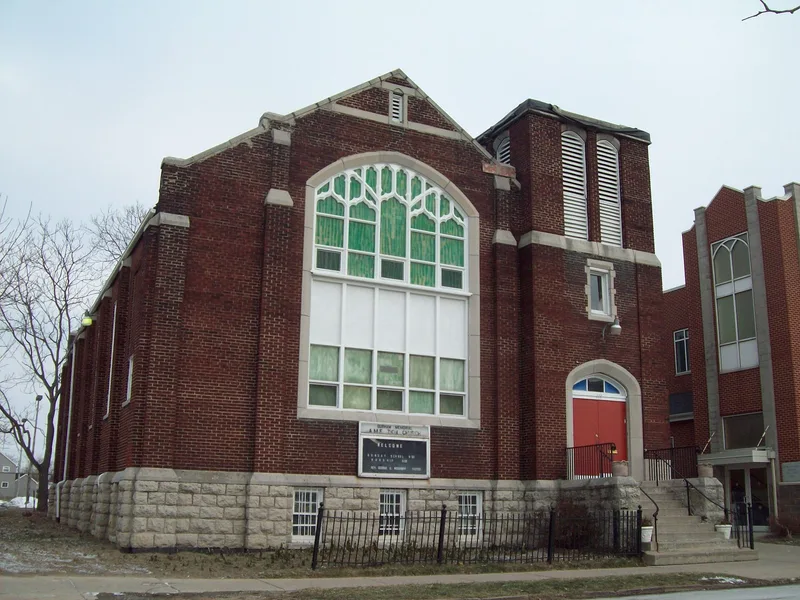
Durham Memorial A.M.E. Zion Church, originally St. Luke's, is a red brick church with sandstone trim at 174 East Eagle Street in Buffalo. Louis Greenstein designed it in 1920, and contractor William A. Walker completed it in 1922. A square, crenellated bell tower stands at the southeast corner, and Tudor-arched openings and Gothic-arched stained-glass windows mark the walls. The congregation began in 1901 and joined the A.M.E. Zion Conference in 1906. It became the first Black congregation in Buffalo to build its own church rather than occupy an existing building. The $50,000 cost was partly covered by wealthy Buffalonians, with the rest financed by a mortgage. The church served as a social, cultural and educational center for Black residents, many of them migrants from the South. It offered job training for youth and adult classes, and during the Depression it ran W.P.A.-funded programs. The building was renamed for Reverend Henry Durham, who oversaw its construction, after most of the congregation moved away in the late 1950s. Buffalo designated it a city landmark in 1979.
Significance in brief: It is presented as the oldest surviving church associated with Buffalo's A.M.E. Zion congregations. St. Luke's was the first black congregation in Buffalo to build its own place of worship. The church served as an educational, social, political and religious center for Black residents, including migrants from the South who came north seeking industrial work.
Machine-generated summary. This summary was generated by a language model from the official nomination document and has not been reviewed line by line by an editor. It may contain errors. Check the source document before relying on any detail. Source: nomination document (PDF) · National Archives catalog entry. NRHP reference 83001670, listed September 15, 1983. Summary generated October 2026 (model claude-sonnet-5-5, prompt v1.0-2026-10-29, confidence high).
Key facts
| Address | 174 E. Eagle St., Buffalo |
|---|---|
| County | Erie County |
| Listed | September 15, 1983 |
| Reference number | 83001670 |
| Resource type | Building |
| Period of significance | 1900- |
| Architect / builder | Louis Greenstein, architect; William A. Walker, contractor |
| Architectural style | Tudor and Gothic Revival details (Tudor-arched openings, Gothic-arched windows, crenellated bell tower) |
| Areas of significance | Black, Social History |
| Level of significance | Local |
| Status (as stated in the nomination) | Occupied and in religious use; altered, with the large front stained-glass window lost to wind damage and replaced with glass block and plain glass, but described as retaining its architectural integrity. |
| Acreage | 0.7 |
| Coordinates | 42.88332, -78.86840 (NPS GIS) |
What listing means for this property
Religious properties are listed for their architectural or historical significance, not their religious use. Listing is honorary and does not restrict the congregation's use of the building. The federal rehabilitation credit is generally unavailable unless part of the building is income-producing; some state programmes and preservation grants do cover religious buildings. Federal funding or permits trigger Section 106 review.
General information, not legal or tax advice. Rules change; confirm with your State Historic Preservation Office or a qualified adviser.
Sources and further reading
- National Park Service, National Register of Historic Places database (snapshot May 2026), reference 83001670.
- Nomination form (PDF, National Archives) — catalog entry
- Wikipedia article (used for cross-checking only; text not reproduced here)
- Wikidata Q5316532
- This listing as JSON
Last updated October 2026. Found an error? See the editorial policy for how to report it.