Poughkeepsie Railroad Bridge

Why it's listed
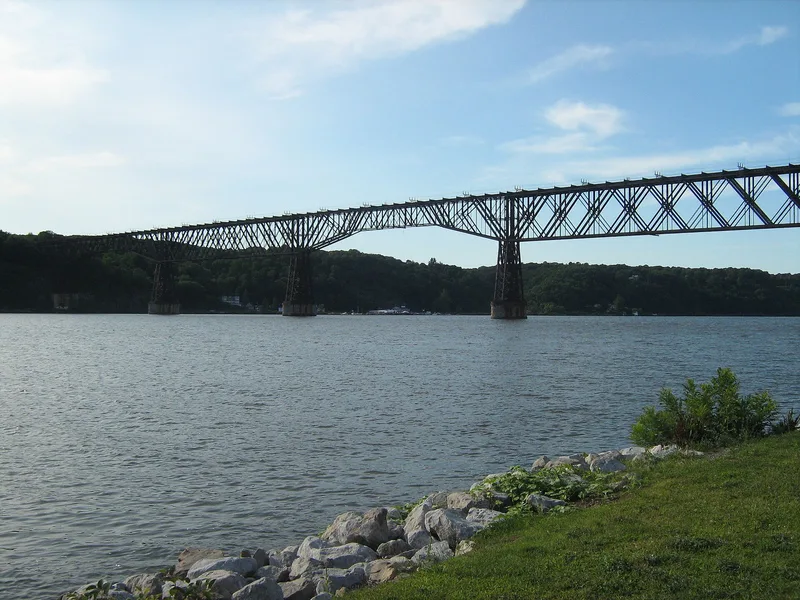
Crossing the Hudson roughly midway between New York City and Albany, this riveted steel railroad bridge runs 6,767 feet with its approaches, linking Poughkeepsie on the east shore to the Highland area on the west. Its river crossing consists of seven deck-truss spans, including a central pair of cantilevers and a suspended span, with rails 342 feet above the foundations. Construction ran from 1876 to 1888 after repeated financial collapses, charter amendments and opposition from boatmen and rival cities. Engineers sank deep river piers through tidal water to bedrock, and the finished structure set records for total length and channel span among steel bridges. The first train crossed on December 29, 1888. Local promoters hoped to carry Pennsylvania coal to New England industry. The bridge was double-tracked at first, later gauntleted and then reduced to a single track in 1959. It has been unused since a 1974 fire damaged part of the deck.
Significance in brief: The nomination presents the bridge as one of the great bridges of the nineteenth century and a major transportation and engineering achievement. Its total length and 548-foot channel span were records for a steel structure. It also reflects the persistence of Poughkeepsie's boosters, who overcame political and financial setbacks to finish a large privately funded project. Later documentation raised the level of significance to national.
Machine-generated summary. This summary was generated by a language model from the official nomination document and has not been reviewed line by line by an editor. It may contain errors. Check the source document before relying on any detail. Source: nomination document (PDF) · National Archives catalog entry. NRHP reference 79001577, listed February 23, 1979. Summary generated October 2026 (model claude-sonnet-5-5, prompt v1.0-2026-10-29, confidence medium).
Key facts
| Address | Spans Hudson River, Poughkeepsie |
|---|---|
| County | Dutchess County |
| Listed | February 23, 1979 |
| Reference number | 79001577 |
| Resource type | Structure |
| Period of significance | 1876-1888 |
| Architect / builder | John F. O'Rourke, chief eng. |
| Areas of significance | Engineering, Transportation |
| Level of significance | National, State |
| Status (as stated in the nomination) | Unused since May 8, 1974, when a fire caused substantial damage to part of the deck. |
| Acreage | 11 |
| Coordinates | 41.71069, -73.95384 (NPS GIS) |
What listing means for this property
For a publicly owned building or structure, listing mainly matters when federal funds, permits or licences are involved: projects then go through Section 106 review so effects on the property are considered. Listing also strengthens applications for preservation grants and, for leased income-producing uses, can enable the federal rehabilitation tax credit.
Noted as vacant in the nomination. Nomination documents can be decades old; current status may differ. If you are considering buying an empty listed property, read the due-diligence checklist.
General information, not legal or tax advice. Rules change; confirm with your State Historic Preservation Office or a qualified adviser.
Sources and further reading
- National Park Service, National Register of Historic Places database (snapshot May 2026), reference 79001577.
- Nomination form (PDF, National Archives) — catalog entry
- Wikipedia article (used for cross-checking only; text not reproduced here)
- Wikidata Q2106712
- This listing as JSON
Last updated October 2026. Found an error? See the editorial policy for how to report it.