Farmer's and Manufacturer's Bank
Also known as: Empire National Bank

Why it's listed
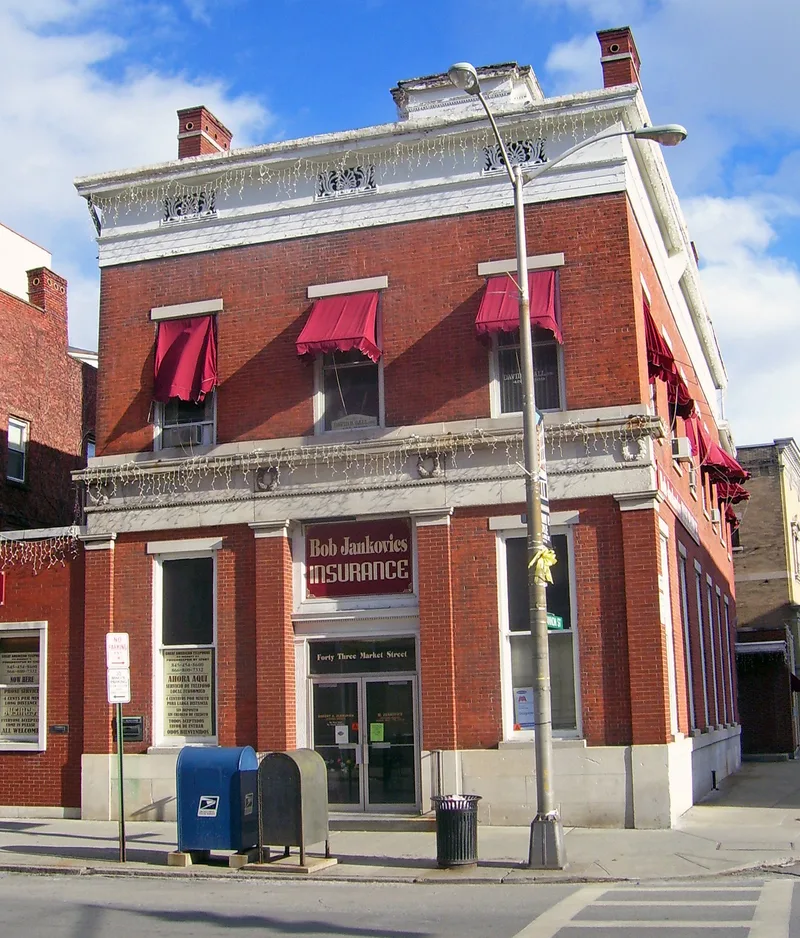
Standing at the corner of Market and Cannon Streets in Poughkeepsie, this two-and-a-half-story brick bank was built in 1834 for the Farmers and Manufacturers Bank, which opened to the public in 1835. It rests on a raised stone basement and has three bays on its facade. A square cupola with corner pilasters sits above a balustrade and a deeply projecting cornice. The wide frieze carries small eyebrow windows with anthemion and vine grillework, along with laurel wreaths. Matthew Vassar was elected to the first board of directors and became the bank's second president. The building has changed over time: its Greek Revival porch was removed in 1892, the doorway was lowered to ground level, and the first-floor interior was modernized, though the upper floors keep period woodwork and mantels. It remains one of a few Greek Revival buildings in the city and one of two non-residential examples. It was long a prominent landmark in views of Market Street.
Significance in brief: The building is notable as a brick interpretation of the Greek Revival style and is one of a handful of Greek Revival structures left in the city. It is one of only two surviving non-residential examples. It is also tied to Matthew Vassar, who served on the first board of directors and was the bank's second president.
Machine-generated summary. This summary was generated by a language model from the official nomination document and has not been reviewed line by line by an editor. It may contain errors. Check the source document before relying on any detail. Source: nomination document (PDF) · National Archives catalog entry. NRHP reference 82001135, listed November 26, 1982. Summary generated October 2026 (model claude-sonnet-5-5, prompt v1.0-2026-10-29, confidence medium).
Key facts
| Address | 43 Market St., Poughkeepsie |
|---|---|
| County | Dutchess County |
| Listed | November 26, 1982 |
| Reference number | 82001135 |
| Resource type | Building |
| Architectural style | Greek Revival |
| Areas of significance | Architecture |
| Level of significance | Local |
| Status (as stated in the nomination) | Described as in good condition and still used as a bank. The doorway was altered and the Greek Revival porch removed in 1892, the first-story windows were elongated, and the interior was modernized around 1953. |
| Acreage | 0.9 |
| Coordinates | 41.70299, -73.92909 (NPS GIS) |
What listing means for this property
For an income-producing building, listing (individually or as a contributing building in a district) is the gateway to the 20% federal rehabilitation tax credit on qualified rehabilitation costs, often stackable with state credits. Work claiming the credit must follow the Secretary of the Interior's Standards and be approved in advance.
Listing does not restrict a private owner acting without federal money or permits; where federal funding or licensing is involved, Section 106 review applies.
General information, not legal or tax advice. Rules change; confirm with your State Historic Preservation Office or a qualified adviser.
Sources and further reading
- National Park Service, National Register of Historic Places database (snapshot May 2026), reference 82001135.
- Nomination form (PDF, National Archives) — catalog entry
- Wikipedia article (used for cross-checking only; text not reproduced here)
- Wikidata Q5435696
- This listing as JSON
Last updated October 2026. Found an error? See the editorial policy for how to report it.