Second Old School Baptist Church of Roxbury

Why it's listed
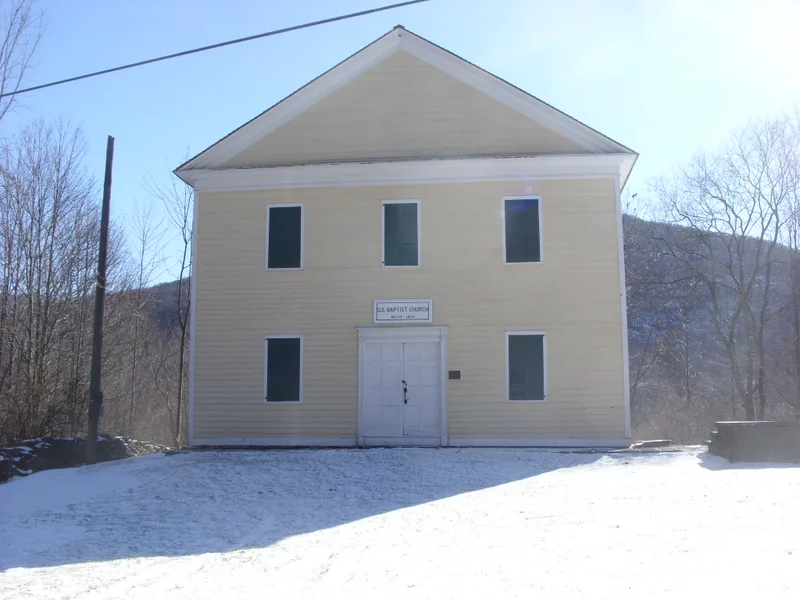
Known locally as the Yellow Church, this Old School Baptist meeting house sits on the east side of County Route 41 south of Roxbury, with its cemetery alongside. The congregation was formed in 1816 from the First Old School Baptist Church at Batavia Kill and met in a schoolhouse for its first seventeen years. Construction of the church began in 1832, and the first services were held there in April 1833. The two-story, hand-hewn timber frame building has clapboard siding, a pedimented gable and a restrained Federal style entrance with paired six-panel doors. Inside, a raised pulpit, a horseshoe gallery, simple wood pews, original plaster and original stoves survive. Windows behind the pulpit follow the traditional meeting house plan. A carriage step and a small outhouse also contribute to the property. The nomination values the church as a well-preserved regional example of the meeting house type, with a cemetery that records local funerary customs.
Significance in brief: The nomination argues the church is an exceptionally intact example of traditional frame meeting house architecture in Delaware County. It retains a restrained Federal style entrance, a raised pulpit, a horseshoe gallery and original finishes. The adjoining cemetery, established at the same time, adds to its setting and significance.
Machine-generated summary. This summary was generated by a language model from the official nomination document and has not been reviewed line by line by an editor. It may contain errors. Check the source document before relying on any detail. Source: nomination document (PDF) · National Archives catalog entry. NRHP reference 99000908, listed July 28, 1999. Summary generated October 2026 (model claude-sonnet-5-5, prompt v1.0-2026-10-29, confidence high).
Key facts
| Address | Cty. Rd. 41, Roxbury |
|---|---|
| County | Delaware County |
| Listed | July 28, 1999 |
| Reference number | 99000908 |
| Resource type | Building |
| Period of significance | 1832-ca. 1949 |
| Architectural style | Early Republic/Federal |
| Criteria |
|
| Areas of significance | Architecture |
| Level of significance | Local |
| Status (as stated in the nomination) | The form notes a lack of use in the late twentieth century, while the building remains virtually intact inside and out. |
| Acreage | 0.9 |
| Coordinates | 42.26487, -74.59485 (NPS GIS) |
What listing means for this property
Religious properties are listed for their architectural or historical significance, not their religious use. Listing is honorary and does not restrict the congregation's use of the building. The federal rehabilitation credit is generally unavailable unless part of the building is income-producing; some state programmes and preservation grants do cover religious buildings. Federal funding or permits trigger Section 106 review.
General information, not legal or tax advice. Rules change; confirm with your State Historic Preservation Office or a qualified adviser.
Sources and further reading
- National Park Service, National Register of Historic Places database (snapshot May 2026), reference 99000908.
- Nomination form (PDF, National Archives) — catalog entry
- Wikipedia article (used for cross-checking only; text not reproduced here)
- Wikidata Q7443455
- This listing as JSON
Last updated October 2026. Found an error? See the editorial policy for how to report it.