Reformed Dutch Church of Claverack

Why it's listed
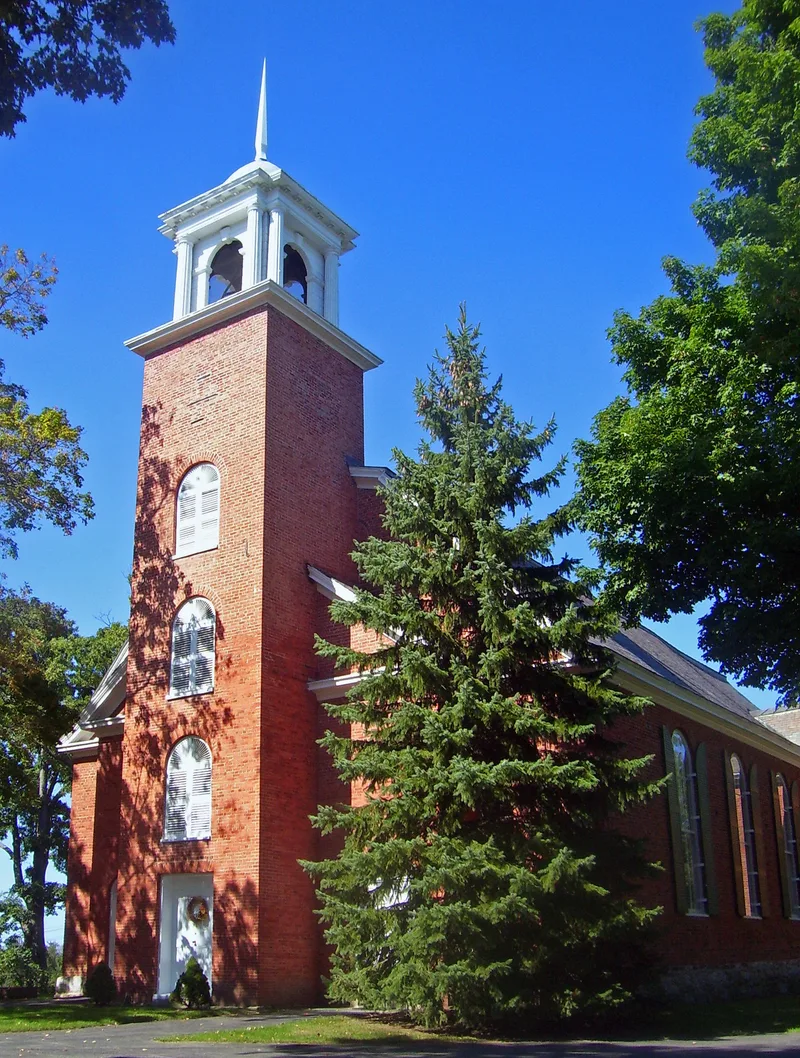
Built in 1767 by Solomon Strong, this red brick church on Route 9H in the hamlet of Claverack, Columbia County, grew in stages. A tower and entrance bay were added in 1828, and a large addition with transept-like wings followed in 1854-55. The gambrel roof, English bond brickwork and the date numerals "1767" on the west wall reflect its Dutch Colonial origins, while the tower and the Victorian windows show later periods. The property also includes an 1844 Greek Revival parsonage, an early 20th-century garage, a stone shed and a 12.7-acre cemetery with gravestones from the 18th century to the present. The congregation was organized in 1716, and one of its early pastors founded the school that became Claverack College. The church is valued as a rare surviving Dutch Colonial church in the county and as a long-standing center of community life. Its period of significance, 1767 to 1879, ends with the installation of the present bell.
Significance in brief: The nomination argues the church is a rare surviving example of Dutch Colonial/Georgian church architecture in Columbia County, with a gambrel roof, English bond brickwork, Federal-period tower and Victorian alterations. It is also historically significant as a congregation organized in 1716 that shaped community life, and one early pastor founded the school later known as Claverack College.
Machine-generated summary. This summary was generated by a language model from the official nomination document and has not been reviewed line by line by an editor. It may contain errors. Check the source document before relying on any detail. Source: nomination document (PDF) · National Archives catalog entry. NRHP reference 01000673, listed June 21, 2001. Summary generated October 2026 (model claude-sonnet-5-5, prompt v1.0-2026-10-29, confidence high).
Key facts
| Address | NY 9H, N of NY 23B, Claverack |
|---|---|
| County | Columbia County |
| Listed | June 21, 2001 |
| Reference number | 01000673 |
| Resource type | Building |
| Period of significance | 1767-1879 |
| Architect / builder | Strong, Solomon (builder) |
| Architectural style | Colonial: Dutch Colonial |
| Criteria |
|
| Areas of significance | Architecture, Social History |
| Level of significance | Local |
| Status (as stated in the nomination) | Still in use as a church and cemetery; the sanctuary appearance is described as unchanged since 1855, apart from cosmetic repairs. |
| Acreage | 17.2 |
| Coordinates | 42.22885, -73.73187 (NPS GIS) |
What listing means for this property
Religious properties are listed for their architectural or historical significance, not their religious use. Listing is honorary and does not restrict the congregation's use of the building. The federal rehabilitation credit is generally unavailable unless part of the building is income-producing; some state programmes and preservation grants do cover religious buildings. Federal funding or permits trigger Section 106 review.
General information, not legal or tax advice. Rules change; confirm with your State Historic Preservation Office or a qualified adviser.
Sources and further reading
- National Park Service, National Register of Historic Places database (snapshot May 2026), reference 01000673.
- Nomination form (PDF, National Archives) — catalog entry
- Wikipedia article (used for cross-checking only; text not reproduced here)
- Wikidata Q2136791
- This listing as JSON
Last updated October 2026. Found an error? See the editorial policy for how to report it.