Hudson Historic District
Also known as: See Also:Front Street-Parade Hill-Lower Warren Street Histor

Why it's listed
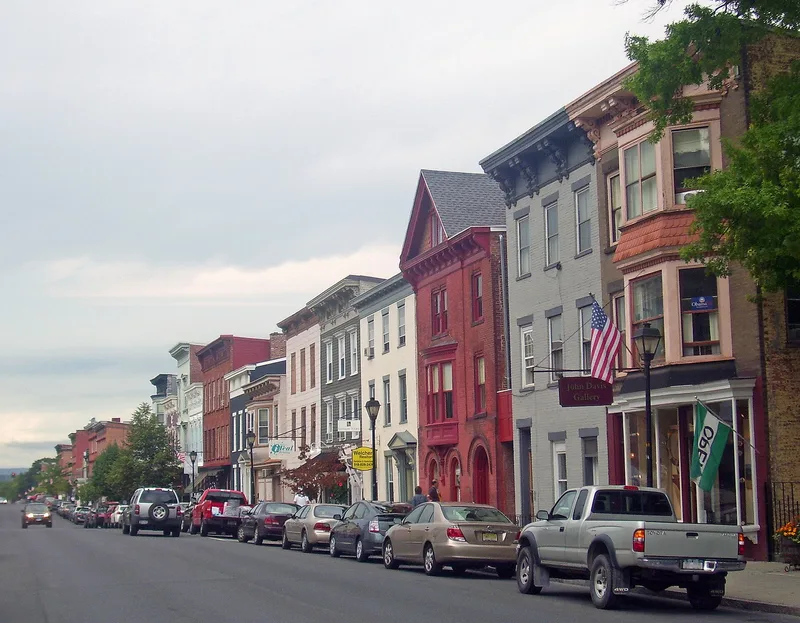
Hudson's historic district covers 139 acres of the Columbia County city, taking in its commercial core and its main residential neighborhoods. The city was planned in 1783 on a grid five streets wide and nine long, and that plan still organizes the area: commercial buildings on Warren Street, public buildings along Warren and Fourth Streets, and houses on Union and Allen Streets. The district counts 756 contributing resources dating from 1783 to 1935. Lower Union Street holds an important group of Federal period houses, including brick gambrel-roofed examples from about 1785, which reflect New England building traditions rather than Dutch ones. Warren Street's nine blocks show a century of commercial ornament from 1835 to 1935, ranging from Greek Revival and Italianate to Queen Anne and Romanesque designs. Later nineteenth-century and early twentieth-century houses, schools, churches, firehouses and railroad-related buildings add to the picture. Boundaries exclude areas heavily altered by demolition or modern construction.
Significance in brief: The district preserves Hudson's original grid plan and a dense, largely intact collection of buildings from 1783 to 1935. It includes an important group of Federal period houses reflecting New England building traditions, and Warren Street's nineteenth- and early twentieth-century commercial architecture. Its public buildings, residences and industrial-related housing show the city's orderly growth over about 200 years.
Machine-generated summary. This summary was generated by a language model from the official nomination document and has not been reviewed line by line by an editor. It may contain errors. Check the source document before relying on any detail. Source: nomination document (PDF) · National Archives catalog entry. NRHP reference 85003363, listed October 21, 1985. Summary generated October 2026 (model claude-sonnet-5-5, prompt v1.0-2026-10-29, confidence medium).
Key facts
| Address | Roughly bounded by Warren and State Sts., Eighth and Seventh Sts., E. Allen and Allen St., and Penn Central RR, Hudson |
|---|---|
| County | Columbia County |
| Listed | October 21, 1985 |
| Reference number | 85003363 |
| Resource type | District |
| Period of significance | 1783-1935 |
| Architect / builder | Henry S. Moul (local architect, 426-428 Warren Street, 1905) |
| Architectural style | Federal, Greek Revival, Italianate, Second Empire, Queen Anne, Romanesque, Colonial Revival and early twentieth century styles |
| Areas of significance | Community Planning and Development, Commerce, Architecture |
| Level of significance | Local |
| Status (as stated in the nomination) | Contains 756 contributing resources and 28 non-contributing primary buildings; some historic buildings on Columbia and State Streets and Front Street were demolished for urban renewal and low-income housing. |
| Acreage | 139 |
| Within district | Front Street-Parade Hill-Lower Warren Street Historic District |
| Coordinates | 42.25515, -73.79443 (NPS GIS) |
What listing means for this property
This is a historic district. Buildings within its boundary are either contributing (they add to the district's significance) or non-contributing. Owners of contributing income-producing buildings can claim the 20% federal rehabilitation tax credit; homeowners should look at state credits. National Register districts impose no design review by themselves; a local historic district ordinance, if one exists, does (the difference explained).
General information, not legal or tax advice. Rules change; confirm with your State Historic Preservation Office or a qualified adviser.
Sources and further reading
- National Park Service, National Register of Historic Places database (snapshot May 2026), reference 85003363.
- Nomination form (PDF, National Archives) — catalog entry
- Wikipedia article (used for cross-checking only; text not reproduced here)
- Wikidata Q1351159
- This listing as JSON
Last updated October 2026. Found an error? See the editorial policy for how to report it.