Quarry Farm

Why it's listed
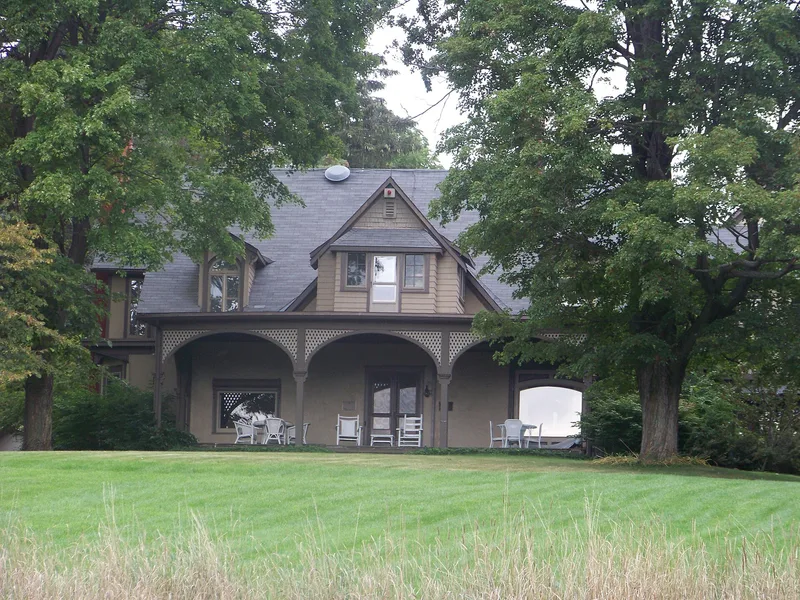
Quarry Farm is a 255-acre hilltop estate on Crane Road in Elmira, New York, with views over the Chemung Valley toward the Pennsylvania line. Its main building is a rambling 1 1/2-2 story stucco farmhouse with wood trim, gabled roofs, shingled dormers, four chimneys and a lattice front porch. A half-timbered library was added in 1923. A cottage and a board and batten barn from the mid-nineteenth century stand nearby, along with stone watering troughs, one marked "Langdon Clemens 1870". Jervis Langdon acquired the house and seven acres in 1849 and gave them to his daughter Susan Langdon Crane. Her sister Olivia married Samuel Clemens, known as Mark Twain, and the Clemens family spent most summers here in the 1870s and 1880s. Twain wrote in an octagonal pilothouse-style study on the property. Parts of Roughing It, Tom Sawyer, A Tramp Abroad and Life on the Mississippi were written here, and nearly all of Huckleberry Finn. The study was moved to Elmira College in 1952.
Significance in brief: The farm was the summer home of Mark Twain and his family during the 1870s and 1880s, at the home of his wife's sister, Mrs. Theodore Crane. Twain wrote parts of several major works there, including nearly all of The Adventures of Huckleberry Finn. The nomination treats the farm as an integral element of his life and work.
Machine-generated summary. This summary was generated by a language model from the official nomination document and has not been reviewed line by line by an editor. It may contain errors. Check the source document before relying on any detail. Source: nomination document (PDF) · National Archives catalog entry. NRHP reference 75001177, listed March 13, 1975. Summary generated October 2026 (model claude-sonnet-5-5, prompt v1.0-2026-10-29, confidence medium).
Key facts
| Address | Crane Rd., Elmira |
|---|---|
| County | Chemung County |
| Listed | March 13, 1975 |
| Reference number | 75001177 |
| Resource type | Building |
| Period of significance | 19th Century; specific date before 1849 |
| Architectural style | Simple farmhouse reminiscent of the picturesque rural cottages popularized by Andrew J. Downing |
| Areas of significance | Literature |
| Level of significance | Local |
| Status (as stated in the nomination) | Condition is given as excellent and altered, on its original site; the interior is described as largely intact. Present use is private residence. |
| Acreage | 255 |
| Coordinates | 42.11036, -76.78243 (NPS GIS) |
What listing means for this property
National Register listing is honorary for a privately owned home: it does not by itself restrict what an owner may do with their own money, and it does not require public access. Restrictions come from local landmark or historic-district ordinances, which are separate (how they differ).
Owner-occupied houses are not eligible for the 20% federal rehabilitation tax credit, which applies to income-producing buildings, but many states offer credits for homeowners. Listing also opens the door to preservation easements and to buying a plaque. Start with what listing means for homeowners, renovating a listed house and selling one.
General information, not legal or tax advice. Rules change; confirm with your State Historic Preservation Office or a qualified adviser.
Sources and further reading
- National Park Service, National Register of Historic Places database (snapshot May 2026), reference 75001177.
- Nomination form (PDF, National Archives) — catalog entry
- Wikipedia article (used for cross-checking only; text not reproduced here)
- Wikidata Q7269211
- This listing as JSON
Last updated October 2026. Found an error? See the editorial policy for how to report it.