Ellicottville Historic District
Also known as: See Also:Ellicottville Town Hall
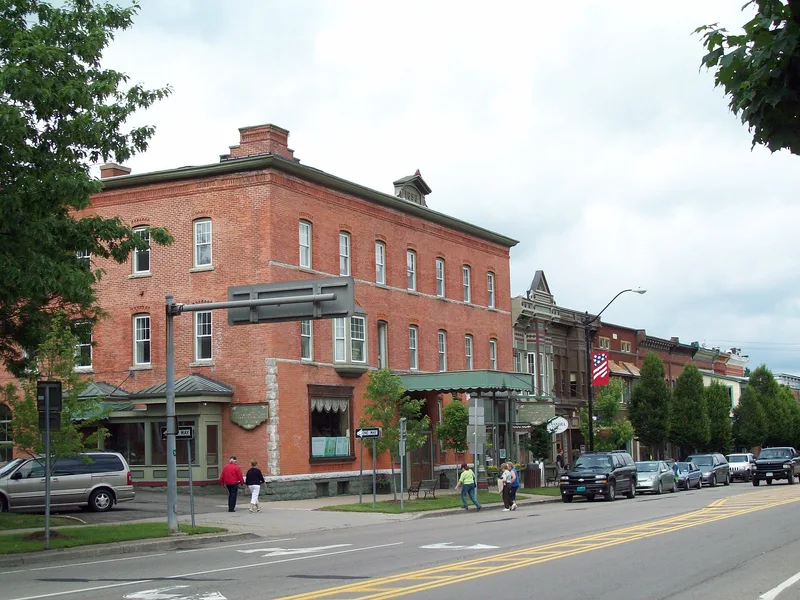

Why it's listed
Ellicottville Historic District covers the core of a village in western New York laid out around 1817 on a planned grid. Two main streets, Washington and Jefferson, cross at a public square, where the county courthouse, clerk's office, school and St. John's Episcopal Church were originally sited. The district includes the commercial blocks along Washington and Monroe Streets, largely rebuilt in brick after an 1890 fire, along with a civic zone on Jefferson Street and a residential zone on West Washington Street. Buildings range from Federal-style houses and a stepped-gable courthouse to Gothic Revival, Italianate and Queen Anne structures, and the "Brick Block" of 1852-3 has an iron storefront and cornice. A 1990 village survey set the boundaries to include buildings that retain integrity from c1817 to 1935. The district was listed because it preserves the village plan and the civic, commercial, religious, educational and residential architecture of that period.
Significance in brief: The district keeps the physical integrity of a planned Holland Land Company village from c1817 to 1935. Its symmetrical street plan, public square with civic buildings, post-1890 fire-rebuilt commercial blocks and residential West Washington Street show how the village developed. The full Section 8 statement and criteria are not in the supplied text.
Machine-generated summary. This summary was generated by a language model from the official nomination document and has not been reviewed line by line by an editor. It may contain errors. Check the source document before relying on any detail. Source: nomination document (PDF) · National Archives catalog entry. NRHP reference 91001028, listed August 22, 1991. Summary generated October 2026 (model claude-sonnet-5-5, prompt v1.0-2026-10-29, confidence medium).
Key facts
| Address | Roughly bounded by Elizabeth, Monroe, Martha and Adams Sts., Ellicottville |
|---|---|
| County | Cattaraugus County |
| Listed | August 22, 1991 |
| Reference number | 91001028 |
| Resource type | District |
| Period of significance | c1817-1935 |
| Architectural style | Early Republic (Early Classical), Mid-19th Century (Greek Revival and other), Late Victorian (Italianate, Queen Anne), Federal, Gothic Revival |
| Areas of significance | Community Planning and Development, Exploration/Settlement, Architecture |
| Level of significance | Local |
| Status (as stated in the nomination) | Current functions include single dwellings, specialty stores, city hall, religious facilities and a museum. The district has 80 contributing and 13 noncontributing resources, including the Ellicottville Town Hall, previously listed in 1972. |
| Acreage | 31 |
| Coordinates | 42.27711, -78.67195 (NPS GIS) |
What listing means for this property
This is a historic district. Buildings within its boundary are either contributing (they add to the district's significance) or non-contributing. Owners of contributing income-producing buildings can claim the 20% federal rehabilitation tax credit; homeowners should look at state credits. National Register districts impose no design review by themselves; a local historic district ordinance, if one exists, does (the difference explained).
General information, not legal or tax advice. Rules change; confirm with your State Historic Preservation Office or a qualified adviser.
Sources and further reading
- National Park Service, National Register of Historic Places database (snapshot May 2026), reference 91001028.
- Nomination form (PDF, National Archives) — catalog entry
- Wikipedia article (used for cross-checking only; text not reproduced here)
- Wikidata Q5365317
- This listing as JSON
Last updated October 2026. Found an error? See the editorial policy for how to report it.