Floyd Bennett Field Historic District

Why it's listed
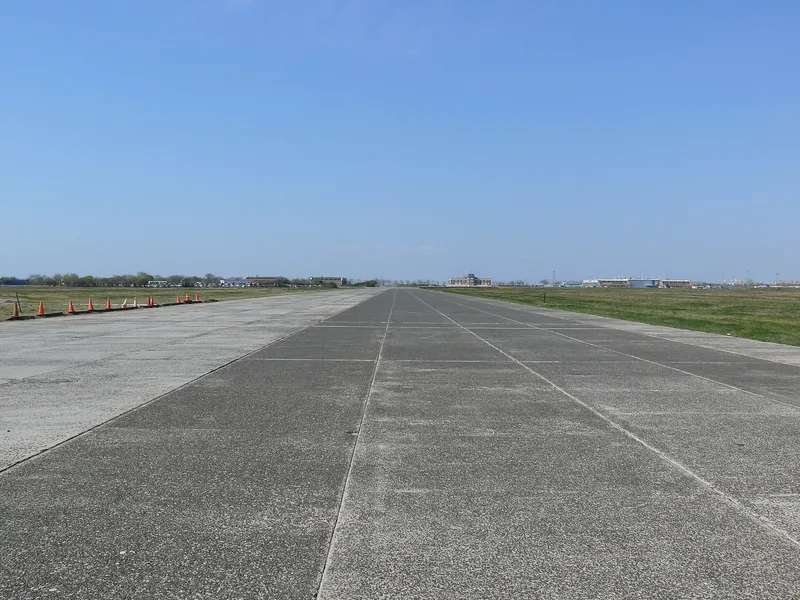
Floyd Bennett Field, on Barren Island in Jamaica Bay, Brooklyn, was New York City's first municipal airport. The City Department of Docks built it between 1928 and 1931, following Department of Commerce guidelines that placed hangars in a line beside the runways and close to Flatbush Avenue. The core of the district is four pairs of steel-frame hangars with brick service wings and Art Deco details, a red and black brick administration building in a neo-Georgian style with a control booth, and the original runway layout. WPA crews added runways and joined the hangar pairs in 1936-1938. The Navy took over the field in 1941 and enlarged it, and the National Park Service later acquired it. In the early 1930s it ranked among the country's busiest airports, and its long runways drew record-seeking fliers including Wiley Post, Howard Hughes and Douglas Corrigan. Because it keeps much of its original buildings and setting, it shows how an early municipal airport worked.
Significance in brief: The nomination argues the field is significant for the evolution of aviation history and municipal airport construction. It was New York City's first municipal airport and followed the 1928 Department of Commerce airport guidelines. It was also a base for record-setting flights by Wiley Post, Howard Hughes and Douglas Corrigan, and it keeps much of its original structures and setting.
Machine-generated summary. This summary was generated by a language model from the official nomination document and has not been reviewed line by line by an editor. It may contain errors. Check the source document before relying on any detail. Source: nomination document (PDF) · National Archives catalog entry. NRHP reference 80000363, listed April 11, 1980. Summary generated October 2026 (model claude-sonnet-5-5, prompt v1.0-2026-10-29, confidence high).
Key facts
| Address | Flatbush Ave., New York |
|---|---|
| County | Brooklyn |
| Listed | April 11, 1980 |
| Reference number | 80000363 |
| Resource type | District |
| Period of significance | 1928-31 |
| Architect / builder | New York City Department of Docks |
| Architectural style | Neo-Georgian (administration building); Art Deco ornamentation on hangars |
| Areas of significance | Commerce, Transportation |
| Level of significance | State, Local |
| Status (as stated in the nomination) | Only Hangars 3 and 4 are occupied, by the New York City Police Department. The administration building is unoccupied and needs rehabilitation. The garage and gasoline pump station are unoccupied. Overall condition is marked fair and altered. |
| Acreage | 328.5 |
| Coordinates | 40.58129, -73.89203 (NPS GIS) |
What listing means for this property
This is a historic district. Buildings within its boundary are either contributing (they add to the district's significance) or non-contributing. Owners of contributing income-producing buildings can claim the 20% federal rehabilitation tax credit; homeowners should look at state credits. National Register districts impose no design review by themselves; a local historic district ordinance, if one exists, does (the difference explained).
General information, not legal or tax advice. Rules change; confirm with your State Historic Preservation Office or a qualified adviser.
Sources and further reading
- National Park Service, National Register of Historic Places database (snapshot May 2026), reference 80000363.
- Nomination form (PDF, National Archives) — catalog entry
- Wikipedia article (used for cross-checking only; text not reproduced here)
- Wikidata Q1430350
- This listing as JSON
Last updated October 2026. Found an error? See the editorial policy for how to report it.