Brooklyn Bridge

Why it's listed
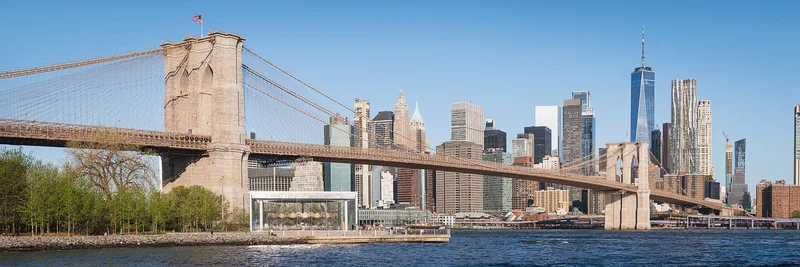
Spanning the East River between Park Row in Manhattan and Adams Street in Brooklyn, this suspension bridge measures 5,989 feet overall, with a main span of 1,595 feet 6 inches. Its deck hangs from four steel cables carried over two limestone and granite towers with Gothic arches. The towers rest on enormous timber caissons filled with compressed air, sunk to the river bed by workers, many of whom suffered from caisson disease. John A. Roebling designed the bridge, and his son Washington A. Roebling directed construction after his father's death in 1869. Work lasted until 1883. For twenty years it was the largest suspension bridge in the world, and it pioneered steel cable and pneumatic caissons on this scale. Originally built for pedestrians, vehicles and cable cars, it later carried trolleys and elevated trains, which ended in 1944. A major upgrade beginning in 1948 widened the roadway with little change to its appearance. It still carries heavy daily traffic.
Significance in brief: The form calls it a national symbol and world-renowned landmark, and says it was the largest suspension bridge in the world for twenty years. Its construction used new techniques, including pneumatic caissons and steel instead of iron cable. It is presented as the culmination of the Roeblings' bridge-building careers and is little altered from its original form.
Machine-generated summary. This summary was generated by a language model from the official nomination document and has not been reviewed line by line by an editor. It may contain errors. Check the source document before relying on any detail. Source: nomination document (PDF) · National Archives catalog entry. NRHP reference 66000523, listed October 15, 1966. Summary generated October 2026 (model claude-sonnet-5-5, prompt v1.0-2026-10-29, confidence high).
Key facts
| Address | Across the East River from Brooklyn to Manhattan, New York |
|---|---|
| County | Brooklyn |
| Listed | October 15, 1966 |
| Reference number | 66000523 |
| Resource type | Structure |
| Period of significance | 1869-1883 |
| Architect / builder | John A. Roebling; Washington A. Roebling |
| Areas of significance | Engineering |
| Level of significance | National |
| National Historic Landmark | Yes, designated January 29, 1964 |
| Status (as stated in the nomination) | Still in use, carrying more than 121,000 cars and trucks daily plus pedestrians on the elevated walkway; condition rated good, altered, on original site. |
| Acreage | 20 |
| Coordinates | 40.70608, -73.99683 (NPS GIS) |
What listing means for this property
For a publicly owned building or structure, listing mainly matters when federal funds, permits or licences are involved: projects then go through Section 106 review so effects on the property are considered. Listing also strengthens applications for preservation grants and, for leased income-producing uses, can enable the federal rehabilitation tax credit.
General information, not legal or tax advice. Rules change; confirm with your State Historic Preservation Office or a qualified adviser.
Sources and further reading
- National Park Service, National Register of Historic Places database (snapshot May 2026), reference 66000523.
- Nomination form (PDF, National Archives) — catalog entry
- Wikipedia article (used for cross-checking only; text not reproduced here)
- Wikidata Q125006
- This listing as JSON
Last updated October 2026. Found an error? See the editorial policy for how to report it.