Whittall Mills

Why it's listed
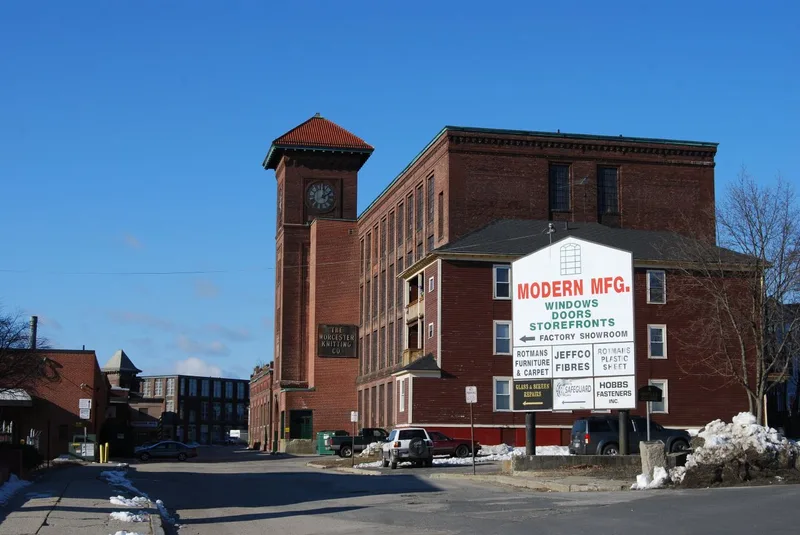
Whittall Mills is a district of brick factory buildings in South Worcester, Massachusetts, beside the Middle River. Most of the three- and four-storey mills date from 1870 to 1910, with later additions to about 1930. The site began as a mill privilege and later housed the Crompton Carpet Company's Packachoag Mill, built in 1870-1872. Crompton and Horace Wyman invented their own power loom for Brussels carpets. After a fire in 1884 and changes of ownership, English immigrant Matthew J. Whittall expanded the property, adding mills, a dye house, power houses, wool storage and main offices, many marked with his name on plaques. Stephen Earle likely designed many of the buildings. By World War I the complex held more than 500,000 square feet of floor space, 350 looms and 1,500 workers, and it supplied carpets to federal buildings and the White House. As South Worcester's largest employer, it encouraged nearby housing growth. Carpet production continued until the company was sold in 1950.
Significance in brief: The complex was the major center of Worcester's large carpet industry from 1870 to about 1930. It grew from the Crompton Carpet Company's early power-loom mill, the second American firm to power-loom Brussels carpets, into Matthew J. Whittall's large operation. By World War I it had over 500,000 square feet of floor space, 350 looms and 1,500 workers, and it shaped South Worcester's development.
Machine-generated summary. This summary was generated by a language model from the official nomination document and has not been reviewed line by line by an editor. It may contain errors. Check the source document before relying on any detail. Source: nomination document (PDF) · National Archives catalog entry. NRHP reference 80000490, listed March 5, 1980. Summary generated October 2026 (model claude-sonnet-5-5, prompt v1.0-2026-10-29, confidence medium).
Key facts
| Address | properties off Brussels St., Worcester |
|---|---|
| County | Worcester County |
| Listed | March 5, 1980 |
| Reference number | 80000490 |
| Resource type | District |
| Period of significance | 1870-1930 |
| Architect / builder | Stephen Earle (likely designer of many buildings); built for Matthew J. Whittall, George Crompton and William J. Hogg |
| Architectural style | Utilitarian industrial |
| Areas of significance | Industry, Community Planning and Development |
| Level of significance | State, Local |
| Status (as stated in the nomination) | The form describes the district as in industrial use, with condition ranging from poor to good. The carpet company was sold in 1950. |
| Acreage | 14.2 |
| Coordinates | 42.23985, -71.81634 (NPS GIS) |
What listing means for this property
This is a historic district. Buildings within its boundary are either contributing (they add to the district's significance) or non-contributing. Owners of contributing income-producing buildings can claim the 20% federal rehabilitation tax credit; homeowners should look at state credits. National Register districts impose no design review by themselves; a local historic district ordinance, if one exists, does (the difference explained).
General information, not legal or tax advice. Rules change; confirm with your State Historic Preservation Office or a qualified adviser.
Sources and further reading
- National Park Service, National Register of Historic Places database (snapshot May 2026), reference 80000490.
- Nomination form (PDF, National Archives) — catalog entry
- Wikipedia article (used for cross-checking only; text not reproduced here)
- Wikidata Q7996830
- This listing as JSON
Last updated October 2026. Found an error? See the editorial policy for how to report it.