Westminster Village-Academy Hill Historic District
Also known as: Westminster Village and Academy Hill

Why it's listed
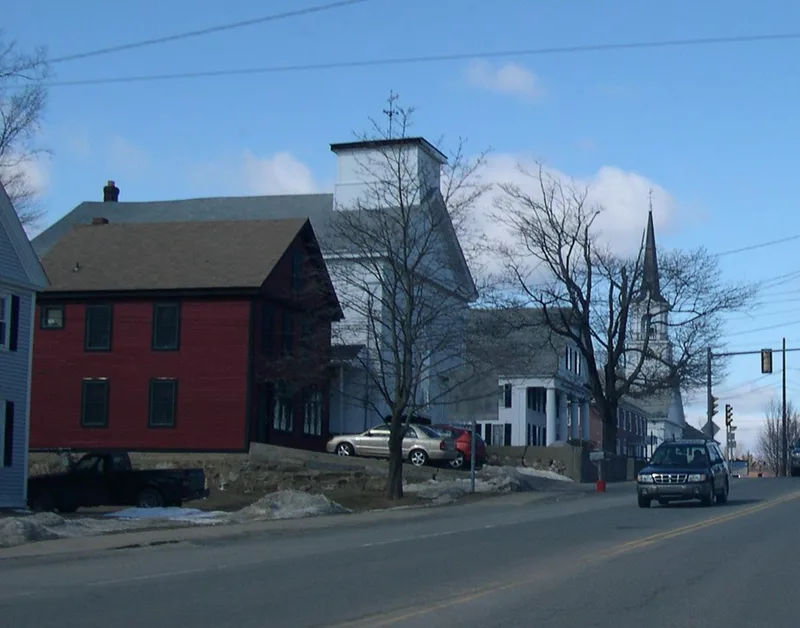
Westminster Village-Academy Hill Historic District covers about 92 acres at the center of Westminster, Massachusetts, and joins two parts of the town's story. Academy Hill was the site of original settlement in the 1730s and 1740s, with the early meetinghouses and ministers' homes, and it later became a place of large houses for prosperous residents. The center village along Main Street grew rapidly after the fifth Massachusetts turnpike opened around 1800 and brought travelers and trade. Its 72 historic buildings include Federal houses, many Greek Revival homes built by local carpenter-builders, a town hall, churches, the Brick Store, a cracker bakery, and the Forbush Library of 1901. Most are white frame houses set close to the street, creating a consistent small-town view. Westminster lost its chance at a main railroad line and shifted from commerce toward a residential community, which helped preserve its early nineteenth-century character.
Significance in brief: The district preserves both the original 18th-century settlement and the early 19th-century village that grew after the fifth Massachusetts turnpike opened in 1801. It is distinguished by consistent streetscapes of Greek Revival and Federal buildings built by local carpenter-builders. The nomination states it meets criteria A, B and C at the local level.
Machine-generated summary. This summary was generated by a language model from the official nomination document and has not been reviewed line by line by an editor. It may contain errors. Check the source document before relying on any detail. Source: nomination document (PDF) · National Archives catalog entry. NRHP reference 83000612, listed June 23, 1983. Summary generated October 2026 (model claude-sonnet-5-5, prompt v1.0-2026-10-29, confidence medium).
Key facts
| Address | Bacon, Adams, Main, Dawley, Academy Hill, Leominster, and Pleasant Sts., Westminster |
|---|---|
| County | Worcester County |
| Listed | June 23, 1983 |
| Reference number | 83000612 |
| Resource type | District |
| Architect / builder | Local carpenter-builders including Joseph Whiteney, Luke Minot, Joseph Minot and J. Nelson Minot; Frost, Briggs and Chamberlain (Forbush Library); Samuel J.F. Thayer of Boston (12 Main Street) |
| Architectural style | Predominantly Greek Revival, with Georgian, Federal, Italianate, Queen Anne/Stick Style and Colonial Revival examples |
| Criteria |
|
| Areas of significance | Industry, Commerce, Historic - Non-Aboriginal, Economics, Education, Politics/Government, Architecture, Religion |
| Level of significance | Local |
| Status (as stated in the nomination) | Most buildings are described as well maintained and rarely altered; the district contains five intrusions. |
| Acreage | 92 |
| Coordinates | 42.54402, -71.90959 (NPS GIS) |
What listing means for this property
This is a historic district. Buildings within its boundary are either contributing (they add to the district's significance) or non-contributing. Owners of contributing income-producing buildings can claim the 20% federal rehabilitation tax credit; homeowners should look at state credits. National Register districts impose no design review by themselves; a local historic district ordinance, if one exists, does (the difference explained).
General information, not legal or tax advice. Rules change; confirm with your State Historic Preservation Office or a qualified adviser.
Sources and further reading
- National Park Service, National Register of Historic Places database (snapshot May 2026), reference 83000612.
- Nomination form (PDF, National Archives) — catalog entry
- Wikipedia article (used for cross-checking only; text not reproduced here)
- Wikidata Q7989229
- This listing as JSON
Last updated October 2026. Found an error? See the editorial policy for how to report it.