Wellington Piano Case Company Building

Why it's listed
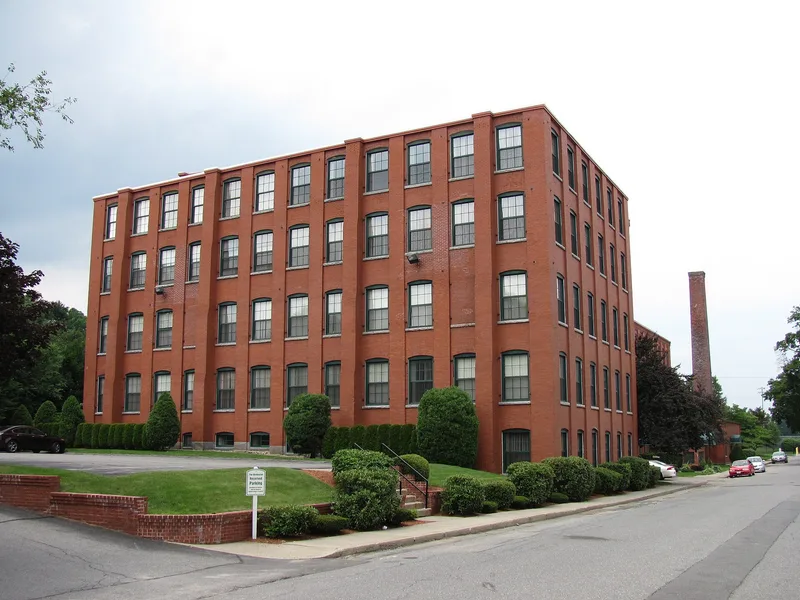
Built in 1895 at 54 Green Street in Leominster, this brick factory made piano cases for the Wellington Piano Case Company. The main section rises four stories, with a central stair tower topped by a crenelated parapet, recessed window bays and corbelled brickwork. A two-story wing, a boiler room with a tall chimney and a five-story addition from 1901 complete the complex. Frank E. Wellington founded the company in 1895, and at about 80,000 square feet the plant was regarded locally as one of the largest of its kind. It employed 150 people and produced about 12,000 cases a year for pianos sold through New York partners. Piano sales fell after World War I, and the company closed in 1929. The 1938 hurricane damaged the building, and local businessmen bought and repaired it for a furniture maker that stayed until 1983. It was listed for its industrial association and typical construction.
Significance in brief: The building is tied to piano and piano case manufacturing, one of Leominster's major industries. It is also representative of late 19th century New England industrial construction. It was considered locally to be among the largest and best-equipped piano case factories in the world.
Machine-generated summary. This summary was generated by a language model from the official nomination document and has not been reviewed line by line by an editor. It may contain errors. Check the source document before relying on any detail. Source: nomination document (PDF) · National Archives catalog entry. NRHP reference 84002922, listed May 31, 1984. Summary generated October 2026 (model claude-sonnet-5-5, prompt v1.0-2026-10-29, confidence high).
Key facts
| Address | 54 Green St., Leominster |
|---|---|
| County | Worcester County |
| Listed | May 31, 1984 |
| Reference number | 84002922 |
| Resource type | Building |
| Period of significance | 1800-1899, 1900- |
| Architect / builder | Unknown |
| Architectural style | Late 19th century functional mill building |
| Criteria |
|
| Areas of significance | Industry, Architecture, Performing Arts |
| Level of significance | Local |
| Status (as stated in the nomination) | Vacant at the time of nomination; the previous tenant left in February 1983, and a developer planned a certified historic rehabilitation into housing. |
| Acreage | 1.5 |
| Coordinates | 42.53512, -71.75543 (NPS GIS) |
What listing means for this property
For an income-producing building, listing (individually or as a contributing building in a district) is the gateway to the 20% federal rehabilitation tax credit on qualified rehabilitation costs, often stackable with state credits. Work claiming the credit must follow the Secretary of the Interior's Standards and be approved in advance.
Listing does not restrict a private owner acting without federal money or permits; where federal funding or licensing is involved, Section 106 review applies.
Noted as vacant in the nomination. Nomination documents can be decades old; current status may differ. If you are considering buying an empty listed property, read the due-diligence checklist.
General information, not legal or tax advice. Rules change; confirm with your State Historic Preservation Office or a qualified adviser.
Sources and further reading
- National Park Service, National Register of Historic Places database (snapshot May 2026), reference 84002922.
- Nomination form (PDF, National Archives) — catalog entry
- Wikipedia article (used for cross-checking only; text not reproduced here)
- Wikidata Q7981454
- This listing as JSON
Last updated October 2026. Found an error? See the editorial policy for how to report it.