Templeton Common Historic District

Why it's listed
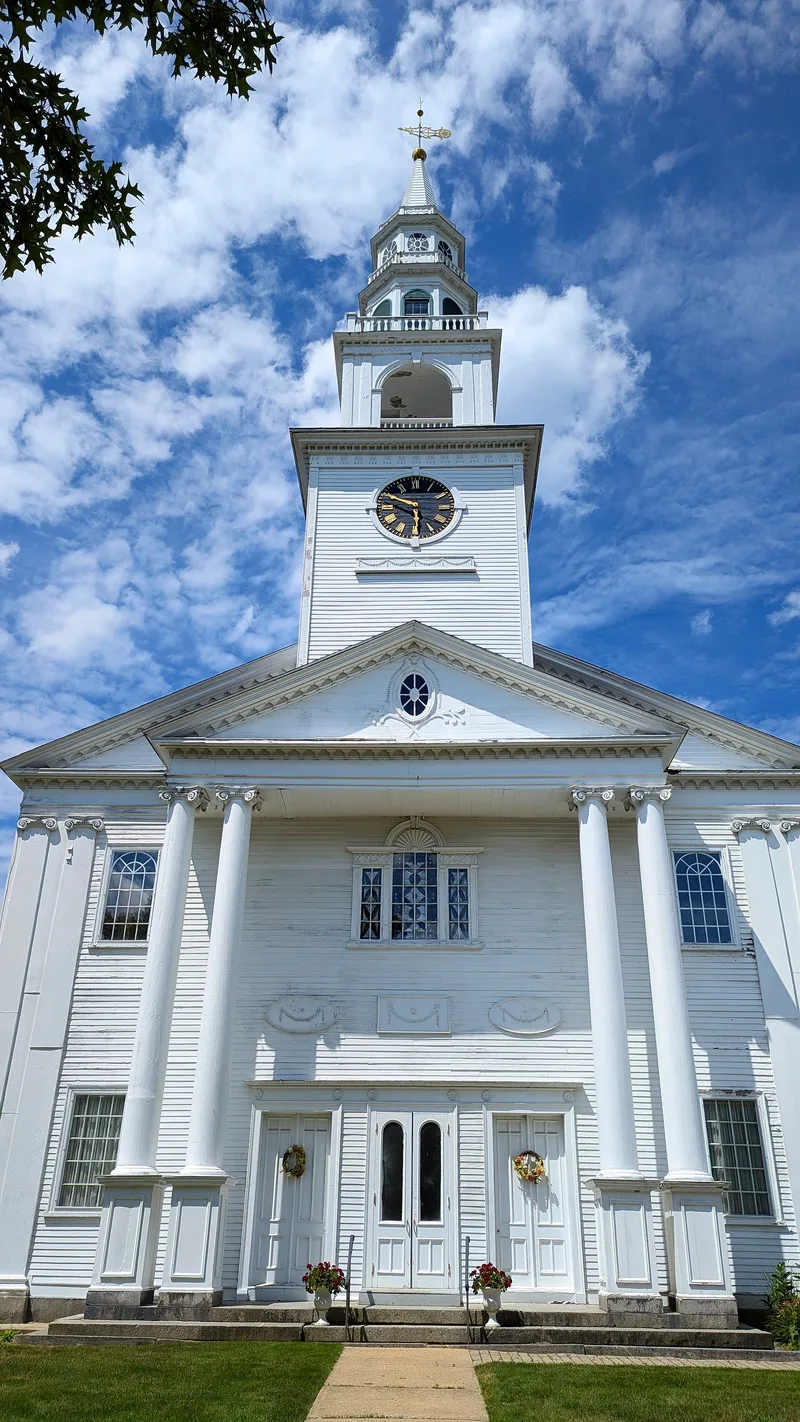
Templeton Common Historic District occupies about 35 acres around the town common, where eight major roads meet along Route 2A in Templeton, Massachusetts. Of its 38 properties, 34 contribute to its character and four are modern intrusions. Most are wood-frame houses of two to two and a half stories built between 1760 and 1860 in Georgian, Federal and Greek Revival styles. The area was the first part of town to be settled, and it holds the 1763 Joshua Wright tavern house, a country store built in 1829, a burying ground with stones dating from 1766, and monuments to soldiers. Several houses served as taverns for stagecoach travelers, and tinware and carriage making were local industries. The 1811 First Church, built by Elias Carter and Jonathan Cutting, is especially notable; its tower and porch design was copied by six later New Hampshire churches. The district has changed little and keeps its original streetscape and landscape.
Significance in brief: The district was the earliest settled part of Templeton and served as the town's center, with ties to prominent 18th and 19th century townspeople. It holds the town's best collection of Georgian, Federal and Greek Revival architecture. The 1811 First Church is an outstanding rural ecclesiastical example whose bell tower and porch design was imitated in six later New Hampshire churches.
Machine-generated summary. This summary was generated by a language model from the official nomination document and has not been reviewed line by line by an editor. It may contain errors. Check the source document before relying on any detail. Source: nomination document (PDF) · National Archives catalog entry. NRHP reference 83000608, listed July 7, 1983. Summary generated October 2026 (model claude-sonnet-5-5, prompt v1.0-2026-10-29, confidence high).
Key facts
| Address | Athol, Gardner, Hubbardston, Dudley, Wellington, and South Rds., Templeton |
|---|---|
| County | Worcester County |
| Listed | July 7, 1983 |
| Reference number | 83000608 |
| Resource type | District |
| Period of significance | 1760-1860 |
| Architect / builder | Elias Carter (First Church of Templeton, with Jonathan Cutting); other builders named include Joshua Wright, Silas Stone, Cyrus Brown, Abijah Jones, John Boynton and Colonel Artemus Lee |
| Architectural style | Georgian, Federal, and Greek Revival |
| Criteria |
|
| Areas of significance | Commerce, Historic - Non-Aboriginal, Education, Architecture |
| Level of significance | Local |
| Status (as stated in the nomination) | Most properties are well preserved and maintained, with few alterations; current uses include residences, a country store, a museum, a church, a library and a park. |
| Acreage | 35 |
| Coordinates | 42.55627, -72.06790 (NPS GIS) |
What listing means for this property
This is a historic district. Buildings within its boundary are either contributing (they add to the district's significance) or non-contributing. Owners of contributing income-producing buildings can claim the 20% federal rehabilitation tax credit; homeowners should look at state credits. National Register districts impose no design review by themselves; a local historic district ordinance, if one exists, does (the difference explained).
General information, not legal or tax advice. Rules change; confirm with your State Historic Preservation Office or a qualified adviser.
Sources and further reading
- National Park Service, National Register of Historic Places database (snapshot May 2026), reference 83000608.
- Nomination form (PDF, National Archives) — catalog entry
- Wikipedia article (used for cross-checking only; text not reproduced here)
- Wikidata Q7698823
- This listing as JSON
Last updated October 2026. Found an error? See the editorial policy for how to report it.