Sturbridge Common Historic District
Also known as: Sturbridge Center; See Also:Oliver Wight House

Why it's listed
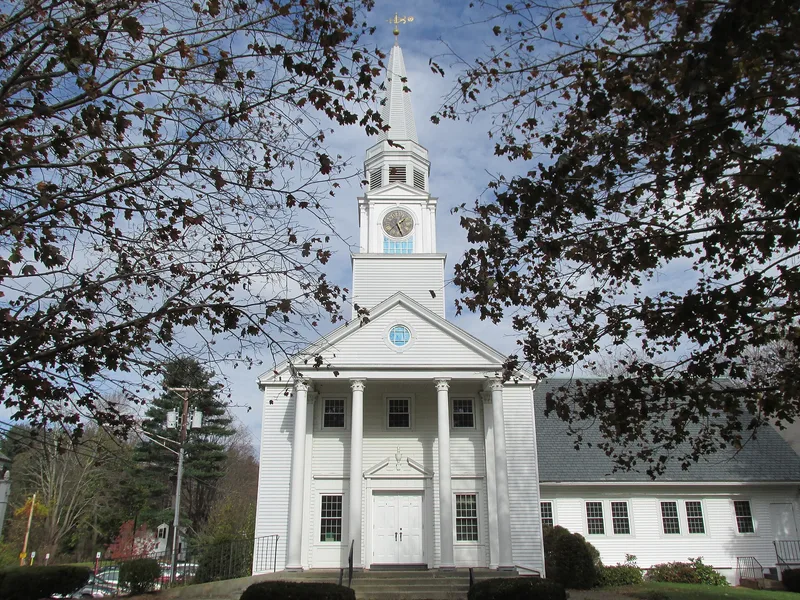
Sturbridge Common Historic District covers 138.15 acres around the town common in central Sturbridge, Massachusetts. The common was set aside as the site of the meeting house and burying ground when the town was incorporated in 1738, and it later became a commercial center where several roads meet. The original six-acre common remains intact. The district holds 47 buildings, including the brick Town Hall of 1838, the Georgian Revival Joshua Hyde Library of 1896, the Classical Revival Federated Church of 1922, and the Publick House, along with houses and former shops. Most are clapboard or shingle. Federal-style buildings date from the 1812 Worcester-Stafford Turnpike, while Greek Revival buildings come from the 1830s. Individual properties carry local stories, such as a general store that operated until 1910 and a house once occupied by portrait painter William Willard. Five intrusions are noted among the otherwise well-preserved buildings.
Significance in brief: The district keeps its original six-acre common and a well-preserved group of public, religious, commercial and residential buildings. Federal-style buildings date from the 1812 Worcester-Stafford Turnpike, and Greek Revival buildings from the 1830s. Many buildings are also of historical interest through their associations with local people and institutions.
Machine-generated summary. This summary was generated by a language model from the official nomination document and has not been reviewed line by line by an editor. It may contain errors. Check the source document before relying on any detail. Source: nomination document (PDF) · National Archives catalog entry. NRHP reference 77000656, listed November 9, 1977. Summary generated October 2026 (model claude-sonnet-5-5, prompt v1.0-2026-10-29, confidence medium).
Key facts
| Address | Main St. between Hall Rd. and I-86, Sturbridge |
|---|---|
| County | Worcester County |
| Listed | November 9, 1977 |
| Reference number | 77000656 |
| Resource type | District |
| Architectural style | Federal and Greek Revival predominate, with Georgian Revival, Classical Revival, Italianate and transitional styles |
| Areas of significance | Industry, Commerce, Education, Politics/Government, Architecture, Agriculture |
| Level of significance | State |
| Status (as stated in the nomination) | Houses around the Common are described as in very good condition; the district includes five intrusions, and the surrounding area has a modern hotel, restaurant and highway. |
| Acreage | 138.2 |
| Coordinates | 42.10803, -72.08017 (NPS GIS) |
What listing means for this property
This is a historic district. Buildings within its boundary are either contributing (they add to the district's significance) or non-contributing. Owners of contributing income-producing buildings can claim the 20% federal rehabilitation tax credit; homeowners should look at state credits. National Register districts impose no design review by themselves; a local historic district ordinance, if one exists, does (the difference explained).
General information, not legal or tax advice. Rules change; confirm with your State Historic Preservation Office or a qualified adviser.
Sources and further reading
- National Park Service, National Register of Historic Places database (snapshot May 2026), reference 77000656.
- Nomination form (PDF, National Archives) — catalog entry
- Wikipedia article (used for cross-checking only; text not reproduced here)
- Wikidata Q7628923
- This listing as JSON
Last updated October 2026. Found an error? See the editorial policy for how to report it.