St. John`s Catholic Church

Why it's listed
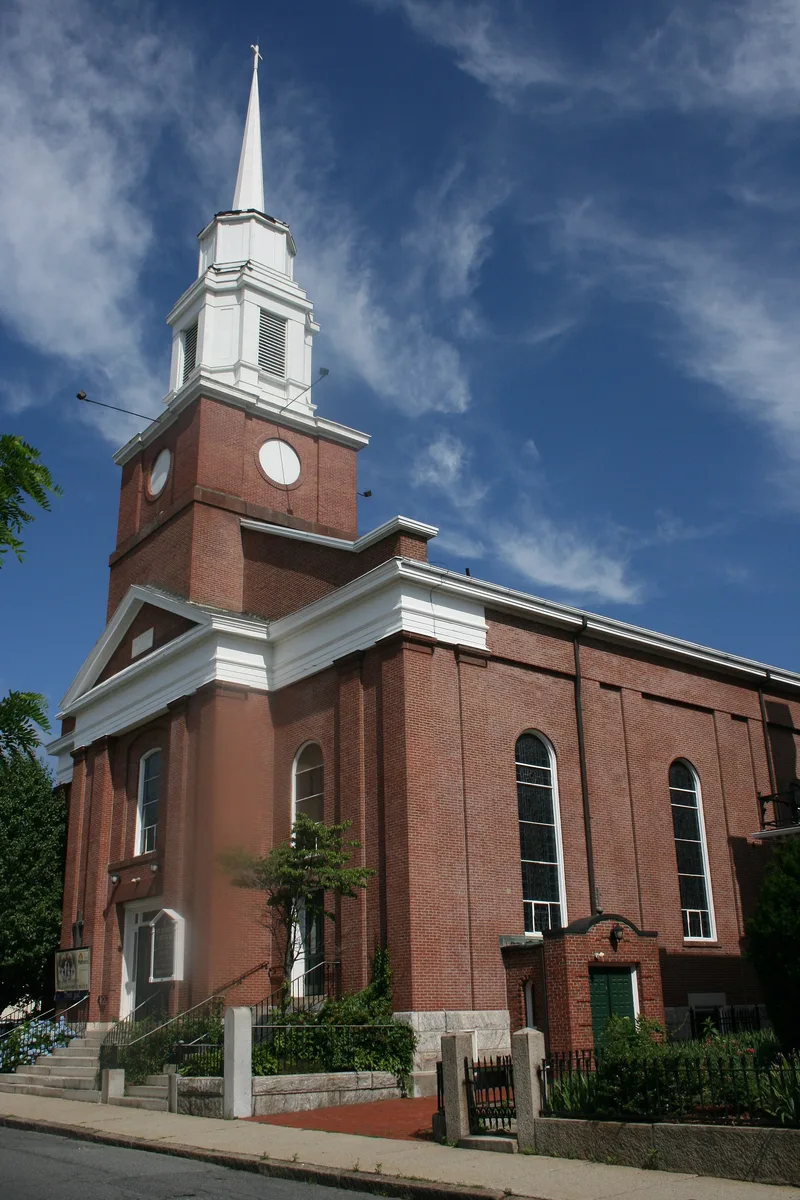
Brick walls, a granite plinth and a pedimented central pavilion mark St. John's Roman Catholic Church on Temple Street in Worcester. Completed by June 1846 on a site cleared in 1845, it is the city's oldest church building and its only Greek Revival church. A square tower with a wooden belfry rises above the facade, though the present spire dates from the 1940s. Side walls are divided into bays by paired brick piers, each holding an arched window. P.W. Ford of Boston planned rear additions in 1884 that left the facade unchanged. The parish dates to 1834, when Father James Fitton began serving about 80 mostly Irish Catholics, and a first wooden church was finished in 1835. As immigration grew in the 1840s, the congregation outgrew that building. St. John's later became known as the mother church of the Springfield diocese, and it supported schools and social services. Membership reached 15,000 by 1910, and Ascension Church was created from the parish in 1911.
Significance in brief: It is the oldest church building in Worcester and the city's only example of Greek Revival church architecture. It also houses Worcester's oldest Catholic parish, founded in 1834, which was central to establishing Catholicism in central Massachusetts and to the history of Irish immigrants in the area.
Machine-generated summary. This summary was generated by a language model from the official nomination document and has not been reviewed line by line by an editor. It may contain errors. Check the source document before relying on any detail. Source: nomination document (PDF) · National Archives catalog entry. NRHP reference 80000619, listed March 5, 1980. Summary generated October 2026 (model claude-sonnet-5-5, prompt v1.0-2026-10-29, confidence medium).
Key facts
| Address | 40 Temple St., Worcester |
|---|---|
| County | Worcester County |
| Listed | March 5, 1980 |
| Reference number | 80000619 |
| Resource type | Building |
| Architect / builder | P.W. Ford (1884 addition) |
| Architectural style | Greek Revival |
| Areas of significance | Architecture, Religion, Social History |
| Level of significance | State, Local |
| Status (as stated in the nomination) | Still in use as a church; the spire was altered around 1940 and the parochial schools have been demolished. |
| Acreage | 2 |
| Coordinates | 42.25975, -71.79637 (NPS GIS) |
What listing means for this property
Religious properties are listed for their architectural or historical significance, not their religious use. Listing is honorary and does not restrict the congregation's use of the building. The federal rehabilitation credit is generally unavailable unless part of the building is income-producing; some state programmes and preservation grants do cover religious buildings. Federal funding or permits trigger Section 106 review.
General information, not legal or tax advice. Rules change; confirm with your State Historic Preservation Office or a qualified adviser.
Sources and further reading
- National Park Service, National Register of Historic Places database (snapshot May 2026), reference 80000619.
- Nomination form (PDF, National Archives) — catalog entry
- Wikipedia article (used for cross-checking only; text not reproduced here)
- Wikidata Q7588596
- This listing as JSON
Last updated October 2026. Found an error? See the editorial policy for how to report it.