Crompton Loom Works

Why it's listed
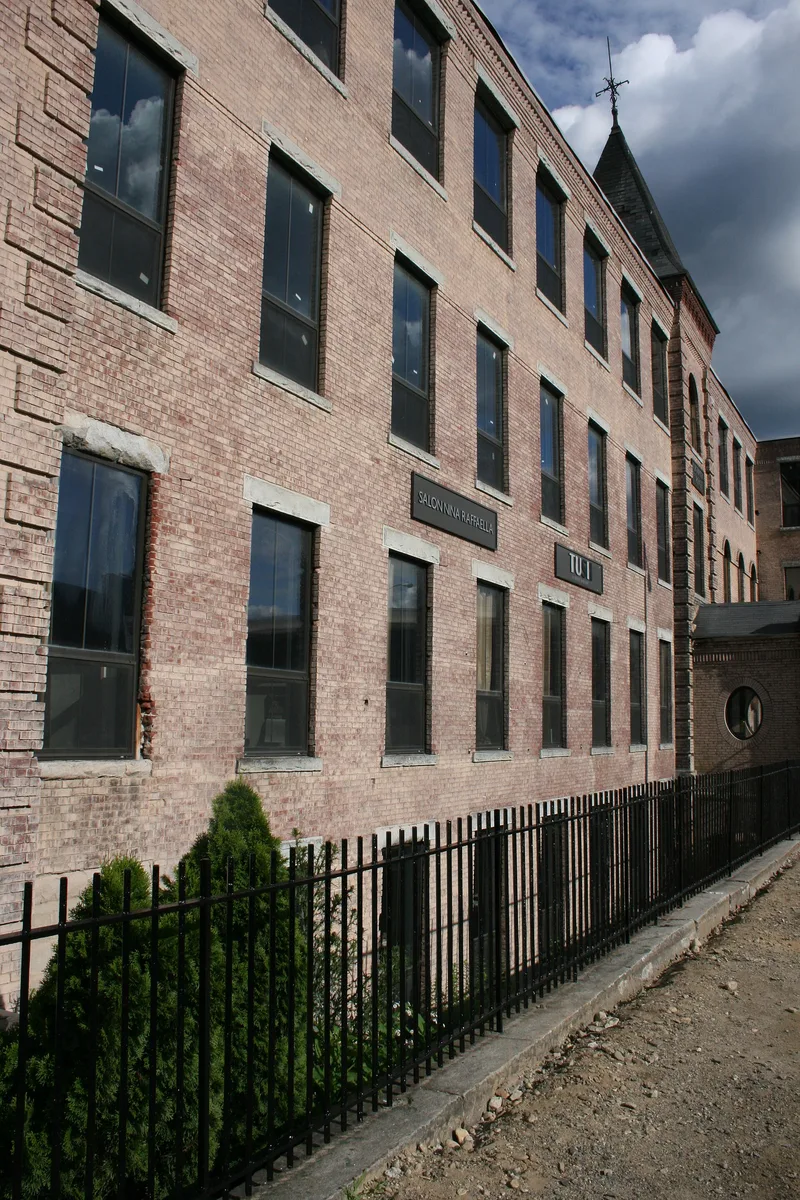
Crompton Loom Works is a brick factory complex at 132-142 Green Street in Worcester, built in stages beginning in 1860. It was erected for the manufacture of power looms and shows Italianate styling with later alterations, including arched second-storey windows and brick quoining. The earliest section was two storeys with a gabled central pavilion. Between 1881 and 1886 a tower was created on the Green Street front and the building was extended north. A third storey was added after 1888, probably around 1900. Further sections date after 1911 and 1922. The works is tied to William Crompton, who patented a fancy-goods power loom in 1836, and his son George, who designed a broad loom in 1857 that quadrupled productivity and won a medal at the 1867 Paris Exposition. The firm later merged with its chief competitor to form Crompton and Knowles. Loom production at this site ended after 1915, and the building now serves industrial and warehouse uses.
Significance in brief: The nomination argues that it is among the oldest factory buildings in Worcester and is tied to one of the city's largest industries, loom manufacturing. It is associated with William and George Crompton, whose loom inventions, including the 1857 broad loom, transformed textile machinery. The form checks the themes of architecture, commerce and industry.
Machine-generated summary. This summary was generated by a language model from the official nomination document and has not been reviewed line by line by an editor. It may contain errors. Check the source document before relying on any detail. Source: nomination document (PDF) · National Archives catalog entry. NRHP reference 80000541, listed March 5, 1980. Summary generated October 2026 (model claude-sonnet-5-5, prompt v1.0-2026-10-29, confidence medium).
Key facts
| Address | 132-142 Green St., Worcester |
|---|---|
| County | Worcester County |
| Listed | March 5, 1980 |
| Reference number | 80000541 |
| Resource type | Building |
| Architectural style | Italianate with alterations |
| Areas of significance | Industry, Architecture, Invention |
| Level of significance | State, Local |
| Status (as stated in the nomination) | Present use is industrial/warehouse; the company ceased production there after 1915 and the building was used for general industry afterward. |
| Acreage | 0.5 |
| Coordinates | 42.25665, -71.79757 (NPS GIS) |
What listing means for this property
For an income-producing building, listing (individually or as a contributing building in a district) is the gateway to the 20% federal rehabilitation tax credit on qualified rehabilitation costs, often stackable with state credits. Work claiming the credit must follow the Secretary of the Interior's Standards and be approved in advance.
Listing does not restrict a private owner acting without federal money or permits; where federal funding or licensing is involved, Section 106 review applies.
General information, not legal or tax advice. Rules change; confirm with your State Historic Preservation Office or a qualified adviser.
Sources and further reading
- National Park Service, National Register of Historic Places database (snapshot May 2026), reference 80000541.
- Nomination form (PDF, National Archives) — catalog entry
- Wikipedia article (used for cross-checking only; text not reproduced here)
- Wikidata Q5187643
- This listing as JSON
Last updated October 2026. Found an error? See the editorial policy for how to report it.