Linwood Historic District
Also known as: Linwood Cotton Mill

Why it's listed
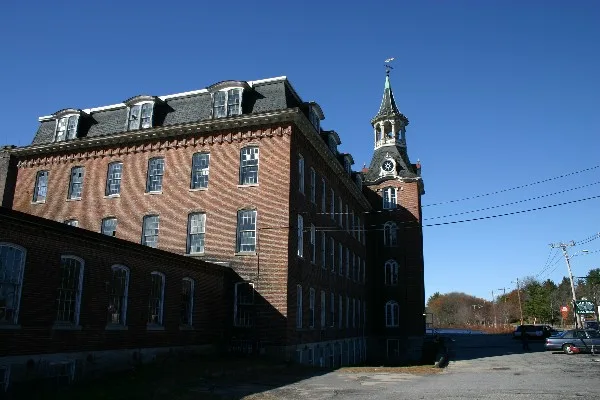
Linwood Mill Historic District covers 37 acres in the village of Linwood, in the southern part of Northbridge, Massachusetts. It centers on the Linwood Cotton Mill, a 3 1/2-story brick Italianate mill built about 1866 with a slate mansard roof and a monumental stair tower. Around it are a brick storehouse, a Second Empire office, a dam and tail race on the Mumford River, and a railroad freight depot, now a restaurant. Worker housing includes dormitories and duplexes in Greek Revival style, and the proprietor's Second Empire mansion sits on a hill to the northwest. The mill was built by members of the Whitin family, who had long dominated cotton manufacturing in Northbridge, and its completion gave Linwood its own identity. The district is valued for its architecture, its link to James Fletcher Whitin and other family members, and its connection to the Providence and Worcester Railroad. The mill complex is vacant, and rehabilitation is pending.
Significance in brief: The district is argued to be significant for its architecture and for its role in Northbridge's cotton manufacturing history. It reflects the contributions of James Fletcher Whitin, Charles P. Whitin and other Whitin family members to the town's cotton industry. It is also tied to mid-to-late 19th-century rail transportation. It is rated significant at the local level under Criteria A, B and C.
Machine-generated summary. This summary was generated by a language model from the official nomination document and has not been reviewed line by line by an editor. It may contain errors. Check the source document before relying on any detail. Source: nomination document (PDF) · National Archives catalog entry. NRHP reference 88002753, listed June 16, 1989. Summary generated October 2026 (model claude-sonnet-5-5, prompt v1.0-2026-10-29, confidence high).
Key facts
| Address | Roughly Linwood Ave., Maple Ct., and Pine Ct., Northbridge |
|---|---|
| County | Worcester County |
| Listed | June 16, 1989 |
| Reference number | 88002753 |
| Resource type | District |
| Period of significance | ca. 1857-1902 |
| Architect / builder | unknown (architect and craftsmen not identified) |
| Architectural style | Greek Revival, Italianate, Second Empire, and mid to late 19th-century industrial |
| Criteria |
|
| Areas of significance | Industry, Architecture |
| Level of significance | Local |
| Status (as stated in the nomination) | The mill complex is vacant, with rehabilitation pending. The Whitin residence operates as an inn, the worker housing has been converted to apartments, and the freight depot is a restaurant. |
| Acreage | 37 |
| Coordinates | 42.09934, -71.64753 (NPS GIS) |
What listing means for this property
This is a historic district. Buildings within its boundary are either contributing (they add to the district's significance) or non-contributing. Owners of contributing income-producing buildings can claim the 20% federal rehabilitation tax credit; homeowners should look at state credits. National Register districts impose no design review by themselves; a local historic district ordinance, if one exists, does (the difference explained).
Noted as vacant in the nomination. Nomination documents can be decades old; current status may differ. If you are considering buying an empty listed property, read the due-diligence checklist.
General information, not legal or tax advice. Rules change; confirm with your State Historic Preservation Office or a qualified adviser.
Sources and further reading
- National Park Service, National Register of Historic Places database (snapshot May 2026), reference 88002753.
- Nomination form (PDF, National Archives) — catalog entry
- Wikipedia article (used for cross-checking only; text not reproduced here)
- Wikidata Q6555168
- This listing as JSON
Last updated October 2026. Found an error? See the editorial policy for how to report it.