Hamilton Woolen Company Historic District

Why it's listed
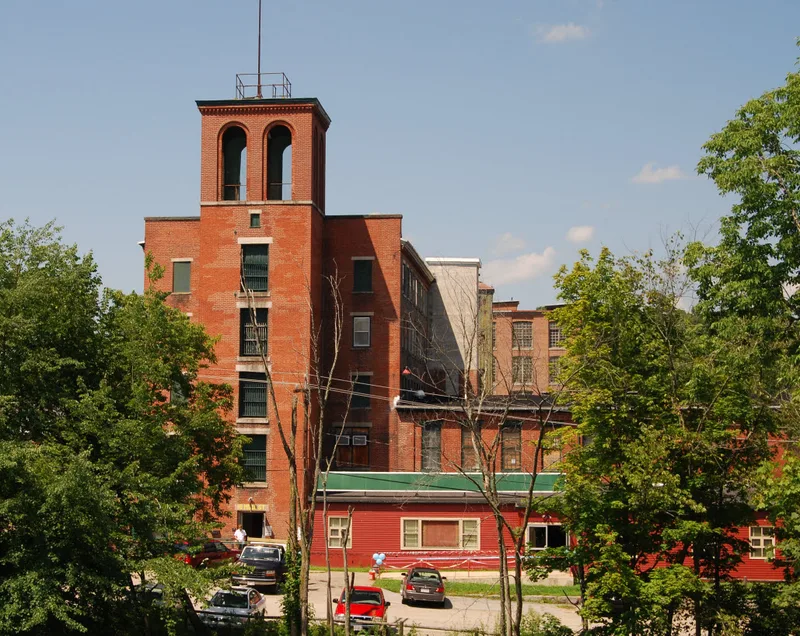
Clustered at the south end of Mill Street in Southbridge, this 3.5-acre district preserves the surviving core of the Hamilton Woolen Company. The five-story brick Big Mill, built in 1836 and rebuilt after a fire in 1850, is recognizable by its end stair tower with a round-arched belfry. Opposite it, a quadrangle of one-and-a-half-story Greek Revival brick tenements housed mill workers. A two-story building dated 1857 and a four-story dye house added in 1929 complete the group. The company grew from earlier water-powered operations at Globe Village, was reorganized with Boston investors in 1831, and became the town's major industry until the American Optical Company overtook it in size. Its expansion, including delaines production from 1844, drew skilled workers and spurred the village's growth. Most of the larger mill complex has been demolished, which makes the survival of a mill together with its worker housing unusual in Southbridge. The district was recognized for its industrial and architectural importance.
Significance in brief: The nomination argues the complex is an unusually well preserved remnant of an early-to-mid 19th century mill, still standing together with its workers' housing, which no other Southbridge mill retains. It was the core of the Hamilton Woolen Company, which dominated the town's economy and drove the growth of Globe Village. It meets criteria A and C at the local level.
Machine-generated summary. This summary was generated by a language model from the official nomination document and has not been reviewed line by line by an editor. It may contain errors. Check the source document before relying on any detail. Source: nomination document (PDF) · National Archives catalog entry. NRHP reference 89000594, listed June 22, 1989. Summary generated October 2026 (model claude-sonnet-5-5, prompt v1.0-2026-10-29, confidence medium).
Key facts
| Address | Roughly bounded by McKinstry Brook, Quinebaug River, and Mill St., Southbridge |
|---|---|
| County | Worcester County |
| Listed | June 22, 1989 |
| Reference number | 89000594 |
| Resource type | District |
| Period of significance | 1836-early 20th C. |
| Architectural style | Greek Revival with Italianate overtones (Big Mill); Greek Revival (Brick Square, Building #8); Classical Industrial (Dye House) |
| Criteria |
|
| Areas of significance | Industry, Architecture |
| Level of significance | Local |
| Status (as stated in the nomination) | Condition described as good. The Big Mill has continued in textile manufacture, other parts have been adapted to other uses, and most Big Mill windows are covered with plywood. |
| Acreage | 3.5 |
| Coordinates | 42.08225, -72.04366 (NPS GIS) |
What listing means for this property
This is a historic district. Buildings within its boundary are either contributing (they add to the district's significance) or non-contributing. Owners of contributing income-producing buildings can claim the 20% federal rehabilitation tax credit; homeowners should look at state credits. National Register districts impose no design review by themselves; a local historic district ordinance, if one exists, does (the difference explained).
General information, not legal or tax advice. Rules change; confirm with your State Historic Preservation Office or a qualified adviser.
Sources and further reading
- National Park Service, National Register of Historic Places database (snapshot May 2026), reference 89000594.
- Nomination form (PDF, National Archives) — catalog entry
- Wikipedia article (used for cross-checking only; text not reproduced here)
- Wikidata Q5645254
- This listing as JSON
Last updated October 2026. Found an error? See the editorial policy for how to report it.