Clark University

Why it's listed
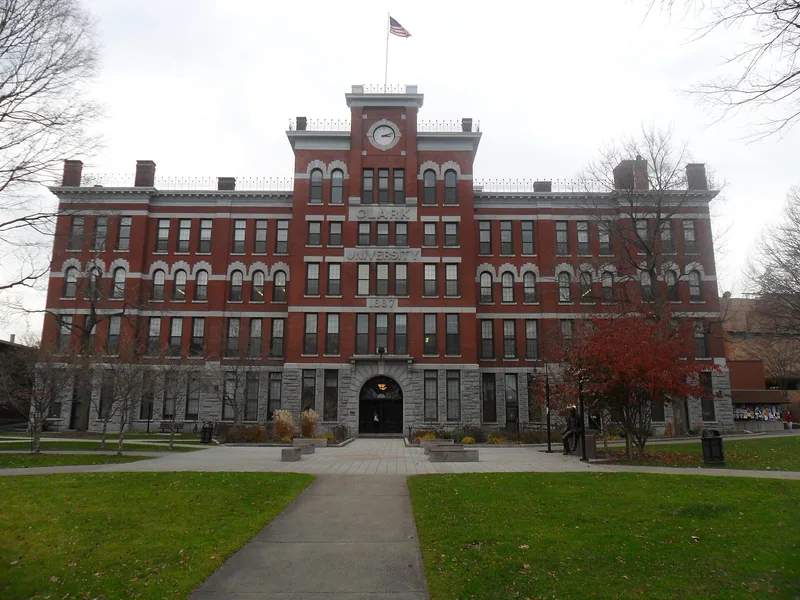
Clark University's historic core in Worcester, Massachusetts, brings together the buildings of a graduate school opened in 1889 with gifts from Jonas G. Clark, a wealthy local businessman. The district centers on Clark Hall, a brick and granite building of 1887 with a clock tower, which Clark wanted to be adaptable to industry if the school failed. Nearby are the Laboratory Building of 1888, where Robert Goddard, later known for high-altitude and liquid-fuel rocketry, studied and worked, and the Collegiate Gothic Academic Building, built as the library in 1901-1903 and extended in 1910. The grounds include a landscaped plaza and a cast-iron fence set in granite posts. The boundaries emphasize the era of G. Stanley Hall, the first president, who led the school from 1889 to 1920 and invited Sigmund Freud to lecture in 1909. Later buildings, Atwood Hall and the Science Building, lie within the district but lack these early associations.
Significance in brief: Clark University was the second graduate school founded in the United States, funded by Jonas G. Clark and shaped by its first president, G. Stanley Hall. The district holds the buildings tied to their founding work, including the lab where Robert Goddard did early rocketry research. The Academic Building is also cited as one of Worcester's finest early examples of Collegiate Gothic architecture.
Machine-generated summary. This summary was generated by a language model from the official nomination document and has not been reviewed line by line by an editor. It may contain errors. Check the source document before relying on any detail. Source: nomination document (PDF) · National Archives catalog entry. NRHP reference 80000547, listed March 5, 1980. Summary generated October 2026 (model claude-sonnet-5-5, prompt v1.0-2026-10-29, confidence high).
Key facts
| Address | Clark University Campus, Worcester |
|---|---|
| County | Worcester County |
| Listed | March 5, 1980 |
| Reference number | 80000547 |
| Resource type | Building |
| Period of significance | 1887-1910 |
| Architect / builder | Stephen Earle (Clark Hall, Laboratory Building); Frost, Briggs & Chamberlain, architects, and Norcross Brothers, builders (Academic Building and addition) |
| Architectural style | Mixed Victorian; Collegiate Gothic (Academic Building) |
| Areas of significance | Education, Architecture |
| Level of significance | State, Local |
| Status (as stated in the nomination) | In use by Clark University; condition described as excellent. |
| Acreage | 7 |
| Coordinates | 42.25109, -71.82253 (NPS GIS) |
What listing means for this property
For a publicly owned building or structure, listing mainly matters when federal funds, permits or licences are involved: projects then go through Section 106 review so effects on the property are considered. Listing also strengthens applications for preservation grants and, for leased income-producing uses, can enable the federal rehabilitation tax credit.
General information, not legal or tax advice. Rules change; confirm with your State Historic Preservation Office or a qualified adviser.
Sources and further reading
- National Park Service, National Register of Historic Places database (snapshot May 2026), reference 80000547.
- Nomination form (PDF, National Archives) — catalog entry
- Wikipedia article (used for cross-checking only; text not reproduced here)
- Wikidata Q1095773
- This listing as JSON
Last updated October 2026. Found an error? See the editorial policy for how to report it.