Howe, Samuel Gridley and Julia Ward, House

Why it's listed
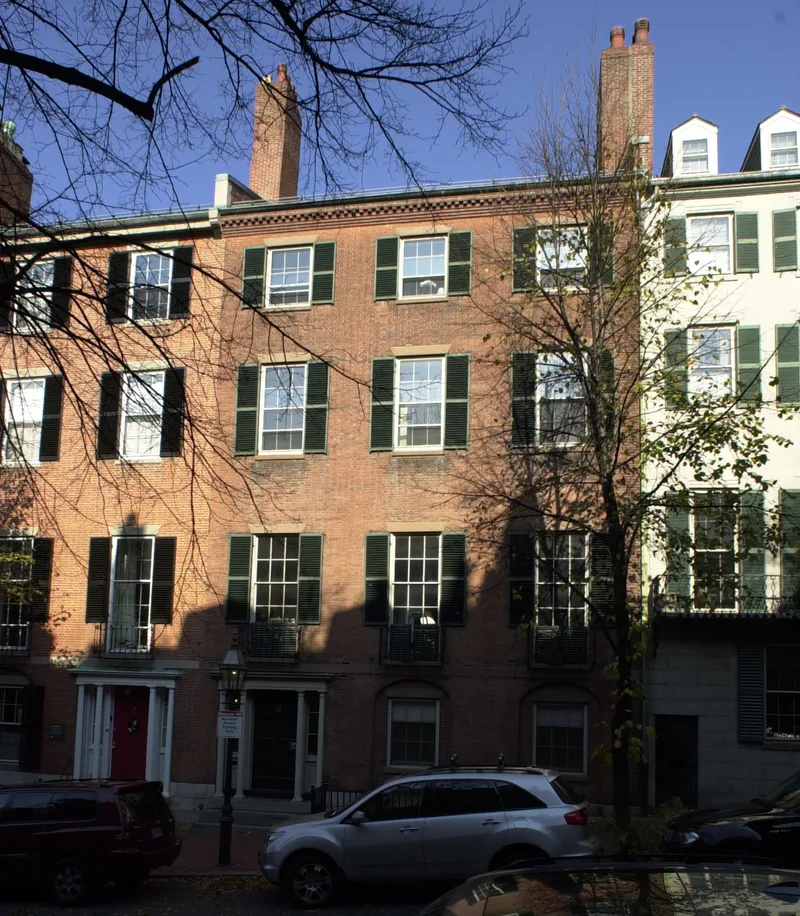
Number 13 Chestnut Street on Beacon Hill is a four-story, three-bay brick row house with a Georgian doorway, arched window recesses on the first story and wrought-iron balconies on the second. Hepsibah Swan built it in 1804-1805 as a wedding present for a daughter, one of three adjoining houses long linked to Charles Bulfinch. It later became the home of John Turner Sargent and, afterward, John Singer Sargent. Its listing rests chiefly on the years 1863 to 1866, when Samuel Gridley Howe, a leader in educating the blind and in state charity reform, lived here with his wife, Julia Ward Howe. In 1863 Julia wrote "The Battle Hymn of the Republic," and in 1865 Samuel began leading the Massachusetts Board of State Charities. The Boston Radical Club later met in the house. Its interiors, including marble mantels and an elliptical staircase, remain well preserved, and it is still a single-family residence.
Significance in brief: The house was the residence of Samuel Gridley Howe and Julia Ward Howe from 1863 to 1866, and is described as the most historically significant of the surviving houses in which they lived. During those years Julia wrote "The Battle Hymn of the Republic" and Samuel began leading the Massachusetts Board of State Charities. It is also architecturally notable as the least altered of the Swan houses.
Machine-generated summary. This summary was generated by a language model from the official nomination document and has not been reviewed line by line by an editor. It may contain errors. Check the source document before relying on any detail. Source: nomination document (PDF) · National Archives catalog entry. NRHP reference 74002044, listed September 13, 1974. Summary generated October 2026 (model claude-sonnet-5-5, prompt v1.0-2026-10-29, confidence high).
Key facts
| Address | 13 Chestnut St., Boston |
|---|---|
| County | Suffolk County |
| Listed | September 13, 1974 |
| Reference number | 74002044 |
| Resource type | Building |
| Period of significance | 1863-1866 |
| Architect / builder | Attributed to Charles Bulfinch (undocumented); built by Hepsibah Swan |
| Architectural style | Georgian doorway; Bulfinch-attributed row house |
| Areas of significance | Architecture, Social History |
| Level of significance | National |
| National Historic Landmark | Yes, designated May 30, 1974 |
| Status (as stated in the nomination) | Condition marked good, altered, original site; remains a single-family private residence with interiors little changed. |
| Acreage | 0.9 |
| Within district | Beacon Hill Historic District |
| Coordinates | 42.35789, -71.06684 (NPS GIS) |
What listing means for this property
National Register listing is honorary for a privately owned home: it does not by itself restrict what an owner may do with their own money, and it does not require public access. Restrictions come from local landmark or historic-district ordinances, which are separate (how they differ).
Owner-occupied houses are not eligible for the 20% federal rehabilitation tax credit, which applies to income-producing buildings, but many states offer credits for homeowners. Listing also opens the door to preservation easements and to buying a plaque. Start with what listing means for homeowners, renovating a listed house and selling one.
General information, not legal or tax advice. Rules change; confirm with your State Historic Preservation Office or a qualified adviser.
Sources and further reading
- National Park Service, National Register of Historic Places database (snapshot May 2026), reference 74002044.
- Nomination form (PDF, National Archives) — catalog entry
- Wikipedia article (used for cross-checking only; text not reproduced here)
- Wikidata Q7411540
- This listing as JSON
Last updated October 2026. Found an error? See the editorial policy for how to report it.