Boston Common and Public Garden
Also known as: Tremont Street Subway; See Also:Boston Common; Boston Public G
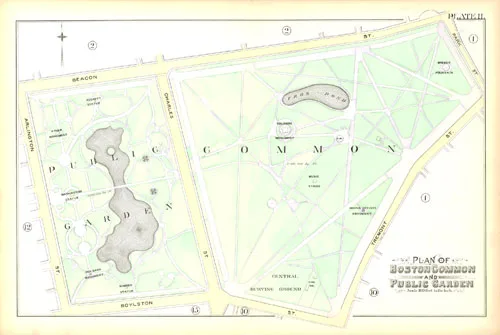

Why it's listed
Boston Common and the adjoining Public Garden form 74 acres of open space at the center of Boston. The Common, set aside in 1634 for pasturage and militia training, is considered the oldest public park in the country. It still has Flagstaff Hill, topped since 1877 by the Soldiers and Sailors Monument, and Frog Pond. During the 1760s and 1770s it was a site of political events and the encampment of British troops. The Central Burying Ground dates from 1756. The Public Garden, on former tidal marshland, grew out of a Botanic Garden founded in 1839 and reached its present limits in 1856. It features a free-form pond with swan boats and naturalistic plantings. Statues and memorials by sculptors such as Augustus St. Gaudens, Daniel Chester French, Thomas Ball and J. Q. A. Ward fill both areas. Surrounding landmarks, including Beacon Hill and the State House, add to the setting.
Significance in brief: The nomination argues the Common and Garden are significant for conservation, landscape architecture, military and political history, and sculpture, across more than three centuries. The Common is considered the oldest public park in the country and served as a militia training ground and Revolutionary-era rallying point and encampment. The Public Garden grew from an 1839 Botanic Garden, and both hold a large collection of monumental sculpture.
Machine-generated summary. This summary was generated by a language model from the official nomination document and has not been reviewed line by line by an editor. It may contain errors. Check the source document before relying on any detail. Source: nomination document (PDF) · National Archives catalog entry. NRHP reference 72000144, listed July 12, 1972. Summary generated October 2026 (model claude-sonnet-5-5, prompt v1.0-2026-10-29, confidence high).
Key facts
| Address | Beacon, Park, Tremont, Boylston, and Arlington Sts., Boston |
|---|---|
| County | Suffolk County |
| Listed | July 12, 1972 |
| Reference number | 72000144 |
| Resource type | District |
| Period of significance | 17th through 20th centuries (specific dates: 1634 Common; 1839-56 Garden) |
| Areas of significance | Landscape Architecture, Art, Conservation, Military, Politics/Government |
| Level of significance | National |
| Status (as stated in the nomination) | Owned by the City of Boston and in public park use; condition rated good and described as altered. The Public Garden's Victorian cast-iron fence is described as deteriorating. |
| Acreage | 74 |
| Within district | Boston Common |
| Coordinates | 42.35502, -71.06784 (NPS GIS) |
What listing means for this property
This is a historic district. Buildings within its boundary are either contributing (they add to the district's significance) or non-contributing. Owners of contributing income-producing buildings can claim the 20% federal rehabilitation tax credit; homeowners should look at state credits. National Register districts impose no design review by themselves; a local historic district ordinance, if one exists, does (the difference explained).
General information, not legal or tax advice. Rules change; confirm with your State Historic Preservation Office or a qualified adviser.
Sources and further reading
- National Park Service, National Register of Historic Places database (snapshot May 2026), reference 72000144.
- Nomination form (PDF, National Archives) — catalog entry
- Wikipedia article (used for cross-checking only; text not reproduced here)
- Wikidata Q4947852
- This listing as JSON
Last updated October 2026. Found an error? See the editorial policy for how to report it.