James, Capt. Benjamin, House

Why it's listed
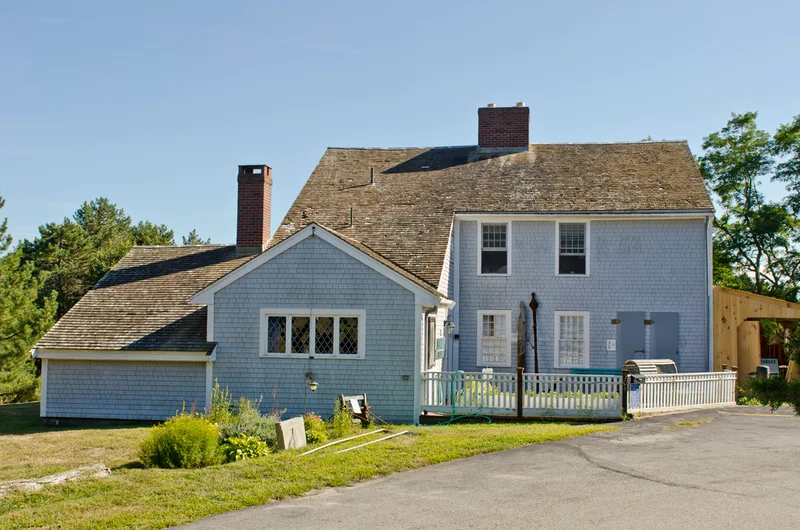
Overlooking the tidal flats of First Herring Brook and the North River, this early 18th century farmhouse at 301 Driftway in Scituate is a center-chimney dwelling with a five-bay, 2½-story main block and a later rear lean-to ell. Oak timbers, cedar shingles and a massive chimney reflect the English vernacular building tradition. The land was part of a grant to John Hanmer, one of the original settlers, and the site shows how early farming depended on marsh hay from the tidal flats. About 1734 the property passed to Captain Benjamin James, a militia officer, who later built a larger house in Greenbush and left this one empty. During the smallpox epidemic of 1791-93, the town used the isolated house as an inoculation hospital, and charred timbers remain from efforts to sterilize it. Although the windows have been replaced and some interior woodwork removed, the house keeps much of its original structure and its relationship to the surrounding landscape.
Significance in brief: The nomination argues the house is a typical vernacular First Period farmhouse and one of the oldest surviving buildings in Scituate, retaining much original fabric. It is also tied to Scituate's early agricultural development along the tidal driftway. In addition, it served as the town's smallpox inoculation hospital, the "Pest House," during the 1791-93 epidemic.
Machine-generated summary. This summary was generated by a language model from the official nomination document and has not been reviewed line by line by an editor. It may contain errors. Check the source document before relying on any detail. Source: nomination document (PDF) · National Archives catalog entry. NRHP reference 83004095, listed November 29, 1983. Summary generated October 2026 (model claude-sonnet-5-5, prompt v1.0-2026-10-29, confidence high).
Key facts
| Address | 301 Driftway, Scituate |
|---|---|
| County | Plymouth County |
| Listed | November 29, 1983 |
| Reference number | 83004095 |
| Resource type | Building |
| Period of significance | 1700-1720 |
| Architectural style | Vernacular First Period farmhouse (English vernacular tradition) |
| Criteria |
|
| Areas of significance | Architecture, Social History |
| Level of significance | Local |
| Status (as stated in the nomination) | Occupied as a private residence; the form lists it as occupied and in fair condition, with an unaltered original site. |
| Acreage | 1 |
| Coordinates | 42.17714, -70.74253 (NPS GIS) |
What listing means for this property
National Register listing is honorary for a privately owned home: it does not by itself restrict what an owner may do with their own money, and it does not require public access. Restrictions come from local landmark or historic-district ordinances, which are separate (how they differ).
Owner-occupied houses are not eligible for the 20% federal rehabilitation tax credit, which applies to income-producing buildings, but many states offer credits for homeowners. Listing also opens the door to preservation easements and to buying a plaque. Start with what listing means for homeowners, renovating a listed house and selling one.
General information, not legal or tax advice. Rules change; confirm with your State Historic Preservation Office or a qualified adviser.
Sources and further reading
- National Park Service, National Register of Historic Places database (snapshot May 2026), reference 83004095.
- Nomination form (PDF, National Archives) — catalog entry
- Wikipedia article (used for cross-checking only; text not reproduced here)
- Wikidata Q5036410
- This listing as JSON
Last updated October 2026. Found an error? See the editorial policy for how to report it.