Holyhood Cemetery

Why it's listed
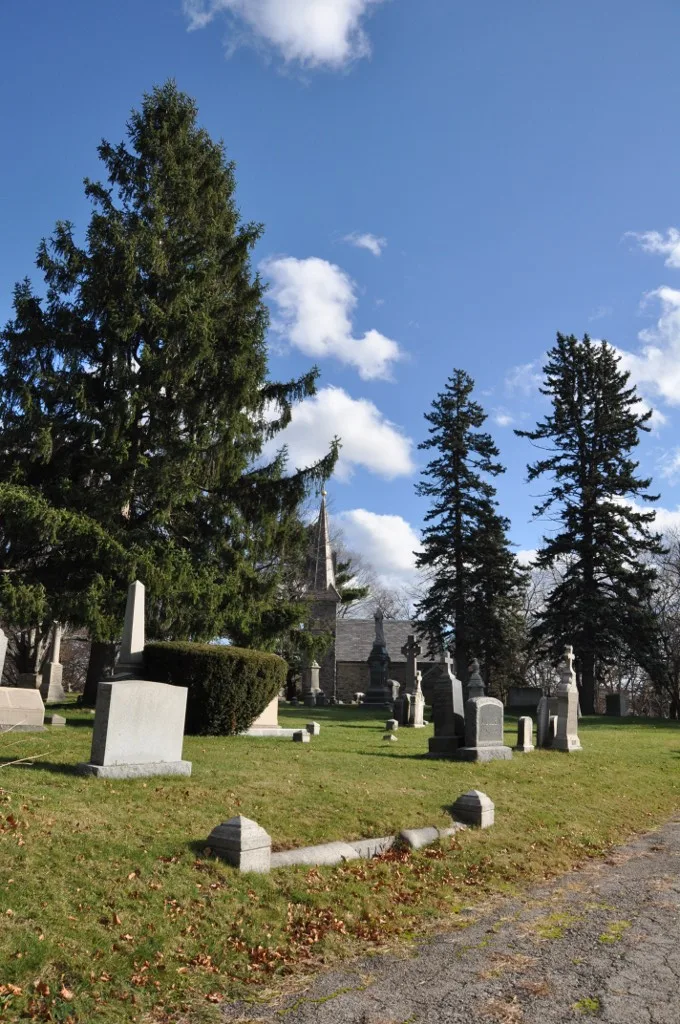
Holyhood Cemetery is a 35-acre Roman Catholic burial ground on Heath Street in Brookline, laid out in 1857 by Father Joseph M. Finotti, pastor of Assumption Parish. Its curving avenues, drawn on an 1857 plan by Shedd & Edson, reflect the romantic landscape cemetery movement that began at Mount Auburn in the 1830s, and it was the first cemetery of that kind in Brookline. The terrain is hilly, with outcroppings of puddingstone and a pine grove behind the chapel. St. Joseph's Chapel, finished in 1862, was designed by New York architect Patrick Keeley in the Gothic Revival style. It is built of puddingstone with granite trim and a side tower with a broach spire, and its bell came from Boston's earlier Cathedral of the Holy Cross. A gridlike section known as the German Acre contrasts with the curved plan. Burials include John Boyle O'Reilly and Joseph P. Kennedy. Roughly 61,000 gravestones mark the grounds, and the property is valued for its design and its chapel.
Significance in brief: The cemetery is an example of romantic landscape cemetery planning, in the tradition begun at Mount Auburn in the 1830s, and was the first such cemetery in Brookline. Its stone chapel was designed by the well-known ecclesiastical architect Patrick Keeley. The form cites these qualities under Criterion C and a cemetery exception for design.
Machine-generated summary. This summary was generated by a language model from the official nomination document and has not been reviewed line by line by an editor. It may contain errors. Check the source document before relying on any detail. Source: nomination document (PDF) · National Archives catalog entry. NRHP reference 85003275, listed October 17, 1985. Summary generated October 2026 (model claude-sonnet-5-5, prompt v1.0-2026-10-29, confidence medium).
Key facts
| Address | Heath St., Brookline |
|---|---|
| County | Norfolk County |
| Listed | October 17, 1985 |
| Reference number | 85003275 |
| Resource type | Site |
| Architect / builder | Patrick Keeley (chapel); Father Joseph M. Finotti (laid out grounds); William S. Wilson (landscape gardener); James Driscoll (superintendent; builder of 1911 service building) |
| Architectural style | Gothic Revival (chapel); romantic landscape cemetery plan |
| Criteria |
|
| Areas of significance | Landscape Architecture, Architecture |
| Level of significance | National, State, Local |
| Status (as stated in the nomination) | Well kept up; about 61,000 gravestones, with some older monuments eroding. Burials continue to the present. An 1886 office building was scheduled for demolition in late 1985, and the 1911 service building was razed in 1985. |
| Acreage | 35 |
| Coordinates | 42.32008, -71.16696 (NPS GIS) |
What listing means for this property
Sites (archaeological sites, battlefields, landscapes) are often listed with a restricted address to protect them from looting or disturbance. Listing is honorary for private owners; federal undertakings on or near the site go through Section 106 review, and state laws may protect burials and artefacts regardless of listing.
General information, not legal or tax advice. Rules change; confirm with your State Historic Preservation Office or a qualified adviser.
Sources and further reading
- National Park Service, National Register of Historic Places database (snapshot May 2026), reference 85003275.
- Nomination form (PDF, National Archives) — catalog entry
- Wikipedia article (used for cross-checking only; text not reproduced here)
- Wikidata Q5887020
- This listing as JSON
Last updated October 2026. Found an error? See the editorial policy for how to report it.