Brandegee Estate
Also known as: Faulkner Farm

Why it's listed
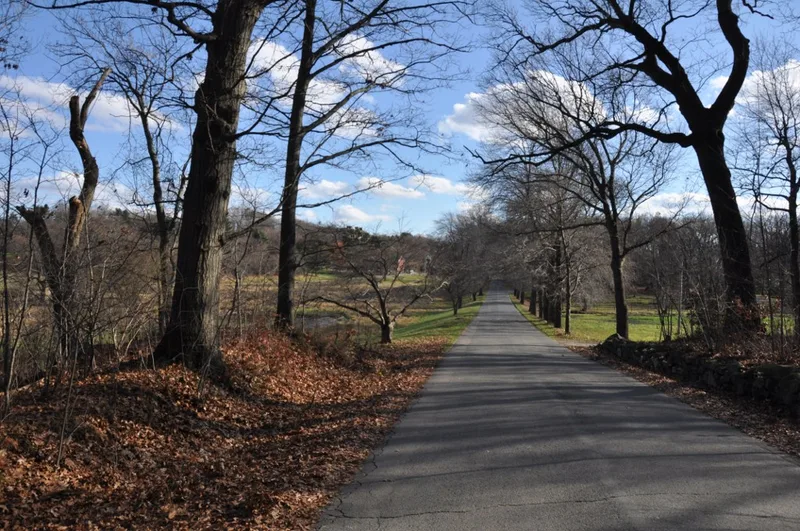
Brandegee Estate is a large country property at 280 Newton Street in Brookline, with a portion extending into Boston. Mary Pratt Sprague, later Mrs. Edward Brandegee, built the original white clapboard house in 1894, designed by Little, Brown & Moore. In 1901 it was encased in brick and given a third floor, giving it a Second Renaissance Revival character. In 1897 Charles Platt was engaged to landscape the grounds, which included a forecourt, a temple, fountains, a large formal garden, a Pompeian-style casino and a pergola. The land was long called Faulkner Farm and had belonged to the Weld family. The estate also holds stables, a carriage house and a greenhouse added in 1930. Its mansion, with about 79 rooms, retains a mahogany dining room, a marble room with a painted ceiling and a ballroom with tapestries. The nomination claims significance through the Weld family connection, the architecture and Platt's garden design. The American Academy of Arts and Sciences occupied the house from 1957.
Significance in brief: The nomination argues the estate meets criteria A, B and C. It cites the land's ties to the Weld family, a fine Renaissance Revival mansion, and gardens originally designed by the nationally known landscape architect Charles Platt. The federal reviewer noted that significance was wrongly attributed to the Weld family and that the case for criteria A or B was not made, though the property may be associated with Mary Pratt Bryant Sprague Brandegee.
Machine-generated summary. This summary was generated by a language model from the official nomination document and has not been reviewed line by line by an editor. It may contain errors. Check the source document before relying on any detail. Source: nomination document (PDF) · National Archives catalog entry. NRHP reference 85003244, listed October 17, 1985. Summary generated October 2026 (model claude-sonnet-5-5, prompt v1.0-2026-10-29, confidence medium).
Key facts
| Address | 280 Newton St., Brookline |
|---|---|
| County | Norfolk County |
| Listed | October 17, 1985 |
| Reference number | 85003244 |
| Resource type | Building |
| Architect / builder | Little, Brown & Moore (architects); Charles Platt (landscape architect) |
| Architectural style | Second Renaissance Revival influence |
| Criteria |
|
| Areas of significance | Architecture |
| Level of significance | National, State, Local |
| Status (as stated in the nomination) | Owned by a charitable trust; the mansion was leased to the American Academy of Arts and Sciences from 1957, the stables house Boston Mounted Police horses, and the estate is now leased to another non-profit. The two stables on the Boston portion remain in good condition. |
| Acreage | 166.1 |
| Coordinates | 42.30512, -71.13870 (NPS GIS) |
What listing means for this property
National Register listing is honorary for a privately owned home: it does not by itself restrict what an owner may do with their own money, and it does not require public access. Restrictions come from local landmark or historic-district ordinances, which are separate (how they differ).
Owner-occupied houses are not eligible for the 20% federal rehabilitation tax credit, which applies to income-producing buildings, but many states offer credits for homeowners. Listing also opens the door to preservation easements and to buying a plaque. Start with what listing means for homeowners, renovating a listed house and selling one.
General information, not legal or tax advice. Rules change; confirm with your State Historic Preservation Office or a qualified adviser.
Sources and further reading
- National Park Service, National Register of Historic Places database (snapshot May 2026), reference 85003244.
- Nomination form (PDF, National Archives) — catalog entry
- Wikipedia article (used for cross-checking only; text not reproduced here)
- Wikidata Q4956622
- This listing as JSON
Last updated October 2026. Found an error? See the editorial policy for how to report it.