Wilson, Henry, Shoe Shop

Why it's listed
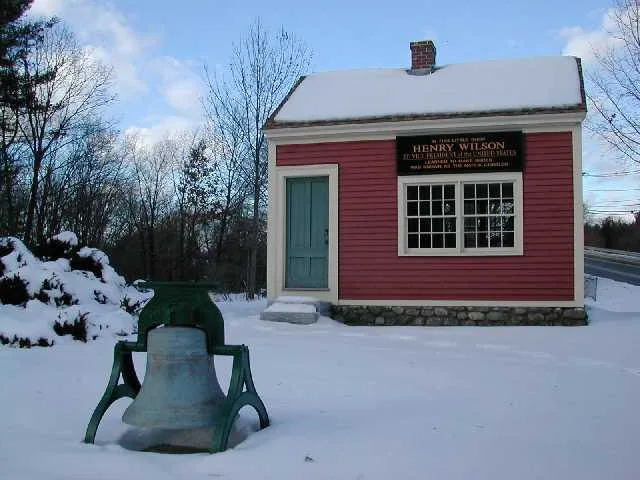
This small clapboard building at 181 West Central Street in West Natick, Massachusetts, is a "ten-footer," the kind of cottage workshop where shoemakers sewed and lasted shoes before factories took over. Measuring about 15 by 10 feet, it was standing by 1833 and was moved back from the road in 1931 onto a cobblestone foundation. Inside is a single room holding lasts, cobbler benches, hammers, awls and early machines donated by townspeople. It is the best surviving example in Natick of a building type once found in nearly every yard. The shop is also remembered as a shrine to Henry Wilson, who became Vice President of the United States. Although his link to this building was brief or perhaps nonexistent, residents repaired and preserved it from the late 1800s onward, and the town received the site as a memorial park in 1927. It now serves as a museum.
Significance in brief: It is a well-preserved example of the ten-footer shoe shops that reflect Natick's early cottage shoemaking industry, and the only known surviving example in Natick. It is also significant as a memorial shrine to Henry Wilson, the town's best-known citizen and later U.S. Vice President, kept up by local residents since the late 19th century.
Machine-generated summary. This summary was generated by a language model from the official nomination document and has not been reviewed line by line by an editor. It may contain errors. Check the source document before relying on any detail. Source: nomination document (PDF) · National Archives catalog entry. NRHP reference 00000955, listed August 24, 2000. Summary generated October 2026 (model claude-sonnet-5-5, prompt v1.0-2026-10-29, confidence high).
Key facts
| Address | 181 W. Central St., Natick |
|---|---|
| County | Middlesex County |
| Listed | August 24, 2000 |
| Reference number | 00000955 |
| Resource type | Building |
| Period of significance | c. 1820-1950 |
| Architectural style | No style |
| Criteria |
|
| Areas of significance | Conservation, Industry |
| Level of significance | Local |
| Status (as stated in the nomination) | Currently used as a museum, with period shoemaking tools and machinery inside; rehabilitated in the 1930s. |
| Acreage | 2.3 |
| Coordinates | 42.28290, -71.38142 (NPS GIS) |
What listing means for this property
For an income-producing building, listing (individually or as a contributing building in a district) is the gateway to the 20% federal rehabilitation tax credit on qualified rehabilitation costs, often stackable with state credits. Work claiming the credit must follow the Secretary of the Interior's Standards and be approved in advance.
Listing does not restrict a private owner acting without federal money or permits; where federal funding or licensing is involved, Section 106 review applies.
General information, not legal or tax advice. Rules change; confirm with your State Historic Preservation Office or a qualified adviser.
Sources and further reading
- National Park Service, National Register of Historic Places database (snapshot May 2026), reference 00000955.
- Nomination form (PDF, National Archives) — catalog entry
- Wikipedia article (used for cross-checking only; text not reproduced here)
- Wikidata Q5730367
- This listing as JSON
Last updated October 2026. Found an error? See the editorial policy for how to report it.