Webster Park Historic District

Why it's listed
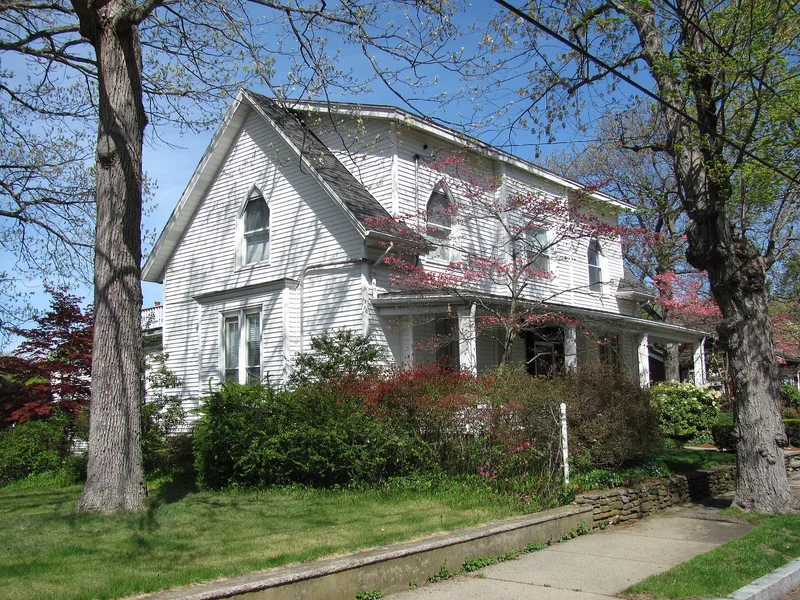
Webster Park Historic District is a residential neighborhood of 26 properties in West Newton, Massachusetts, centered on Webster Street and a small oval park. It was the southwest corner of the Webster Place subdivision, laid out in 1844 by surveyor and landscape architect Alexander Wadsworth for developer William J. Porter, next to the Boston & Worcester Railroad. The district's best-known feature is a group of eight Gothic Revival cottages, originally ten, designed by Boston architect Edward Shaw and built by housewright John Rollins in the late 1840s. Twin gables and central entrance pavilions mark these houses. Later buildings include Italianate, Mansard, and Queen Anne houses, along with an early school moved to the area and converted to a house. Little changed here after 1900. The district is described as one of the least altered early railroad suburbs in Newton, and it was listed for its intact subdivision plan and its architecture.
Significance in brief: It is presented as one of the most intact early residential subdivisions built after the Boston & Worcester Railroad opened in 1834. The original oval park laid out by Alexander Wadsworth survives. A group of eight Gothic Revival cottages designed by Boston architect Edward Shaw is a significant component of the district.
Machine-generated summary. This summary was generated by a language model from the official nomination document and has not been reviewed line by line by an editor. It may contain errors. Check the source document before relying on any detail. Source: nomination document (PDF) · National Archives catalog entry. NRHP reference 86001764, listed September 4, 1986. Summary generated October 2026 (model claude-sonnet-5-5, prompt v1.0-2026-10-29, confidence high).
Key facts
| Address | Along Webster Pk. and Webster St. between Westwood St. and Oak Ave., Newton |
|---|---|
| County | Middlesex County |
| Listed | September 4, 1986 |
| Reference number | 86001764 |
| Resource type | District |
| Period of significance | 1845-1870 |
| Architect / builder | Edward Shaw (architect of the Gothic Revival cottages); John Rollins (builder); Gilbert Patter (carpenter); Alexander Wadsworth (surveyor/landscape architect) |
| Architectural style | Gothic Revival, with Italianate, Mansard, and Queen Anne buildings |
| Criteria |
|
| Areas of significance | Community Planning and Development, Architecture, Social History |
| Level of significance | State, Local |
| Status (as stated in the nomination) | Present use is residential; general condition is given as fair to good. Two contributing-status exceptions are noted: two non-contributing buildings and two vacant lots. |
| Acreage | 11.5 |
| Within district | West Newton Village Center Historic District |
| Coordinates | 42.34973, -71.22797 (NPS GIS) |
What listing means for this property
This is a historic district. Buildings within its boundary are either contributing (they add to the district's significance) or non-contributing. Owners of contributing income-producing buildings can claim the 20% federal rehabilitation tax credit; homeowners should look at state credits. National Register districts impose no design review by themselves; a local historic district ordinance, if one exists, does (the difference explained).
General information, not legal or tax advice. Rules change; confirm with your State Historic Preservation Office or a qualified adviser.
Sources and further reading
- National Park Service, National Register of Historic Places database (snapshot May 2026), reference 86001764.
- Nomination form (PDF, National Archives) — catalog entry
- Wikipedia article (used for cross-checking only; text not reproduced here)
- Wikidata Q7978947
- This listing as JSON
Last updated October 2026. Found an error? See the editorial policy for how to report it.