Staples-Crafts-Wiswall Farm

Why it's listed
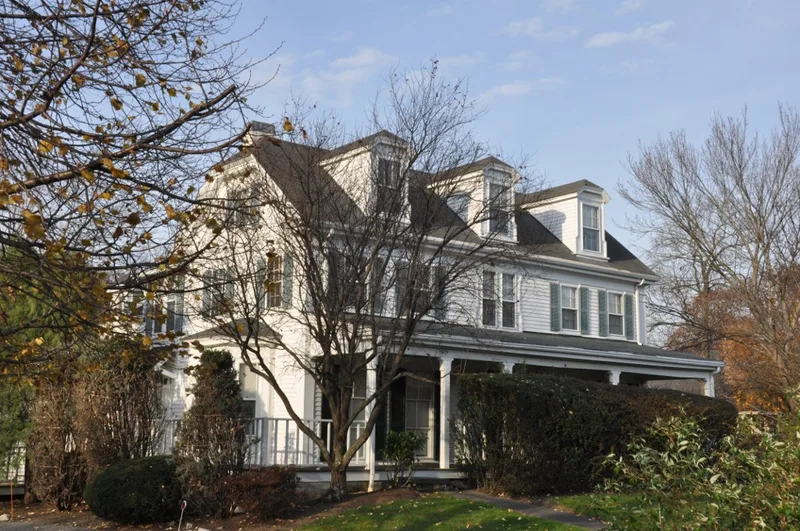
This farmhouse at 1615 Beacon Street in Waban, part of Newton, Massachusetts, occupies the site of the late seventeenth-century home of Deacon John Staples, Newton's first schoolmaster. The present house is greatly altered but incorporates the foundation, structural members and hardware of the Staples dwelling. Moses Craft, raised by the Staples couple, is believed to have rebuilt it in the mid-eighteenth century and added an ell in 1768, which he sold to his son Joseph. In 1824 William Wiswall, a cousin of the Craft family, gave the house a Federal remodelling. In 1858 David Kinmouth, a Boston dry goods merchant, bought it and extensively remodelled it as a stylish summer estate, clipping the gable ends, adding bay windows and extending the porches. The property is valued as a visual link to Waban's eighteenth-century farming origins and for its association with three early local families. It is clad in aluminum siding from the 1970s and remains a dwelling.
Significance in brief: The farmstead is presented as an important visual link to Waban's eighteenth-century agricultural beginnings. It is also tied to the Staples, Crafts and Wiswall families, among the area's earliest inhabitants. The form cites Criteria A and B.
Machine-generated summary. This summary was generated by a language model from the official nomination document and has not been reviewed line by line by an editor. It may contain errors. Check the source document before relying on any detail. Source: nomination document (PDF) · National Archives catalog entry. NRHP reference 86001884, listed September 4, 1986. Summary generated October 2026 (model claude-sonnet-5-5, prompt v1.0-2026-10-29, confidence medium).
Key facts
| Address | 1615 Beacon St., Newton |
|---|---|
| County | Middlesex County |
| Listed | September 4, 1986 |
| Reference number | 86001884 |
| Resource type | Building |
| Architect / builder | Architect unknown; rebuilt in the mid-eighteenth century by Moses Craft, and remodelled by William Wiswall (Federal, 1824) and David Kinmouth (Victorian, 1858) |
| Architectural style | Georgian/Federal/Victorian |
| Criteria |
|
| Areas of significance | Agriculture, Social History |
| Level of significance | State, Local |
| Status (as stated in the nomination) | Condition listed as good; present use is a dwelling. A rear addition and demolition of the rear ell are noted for 1986. |
| Acreage | 0.7 |
| Coordinates | 42.32728, -71.23018 (NPS GIS) |
What listing means for this property
National Register listing is honorary for a privately owned home: it does not by itself restrict what an owner may do with their own money, and it does not require public access. Restrictions come from local landmark or historic-district ordinances, which are separate (how they differ).
Owner-occupied houses are not eligible for the 20% federal rehabilitation tax credit, which applies to income-producing buildings, but many states offer credits for homeowners. Listing also opens the door to preservation easements and to buying a plaque. Start with what listing means for homeowners, renovating a listed house and selling one.
General information, not legal or tax advice. Rules change; confirm with your State Historic Preservation Office or a qualified adviser.
Sources and further reading
- National Park Service, National Register of Historic Places database (snapshot May 2026), reference 86001884.
- Nomination form (PDF, National Archives) — catalog entry
- Wikipedia article (used for cross-checking only; text not reproduced here)
- Wikidata Q14715864
- This listing as JSON
Last updated October 2026. Found an error? See the editorial policy for how to report it.